
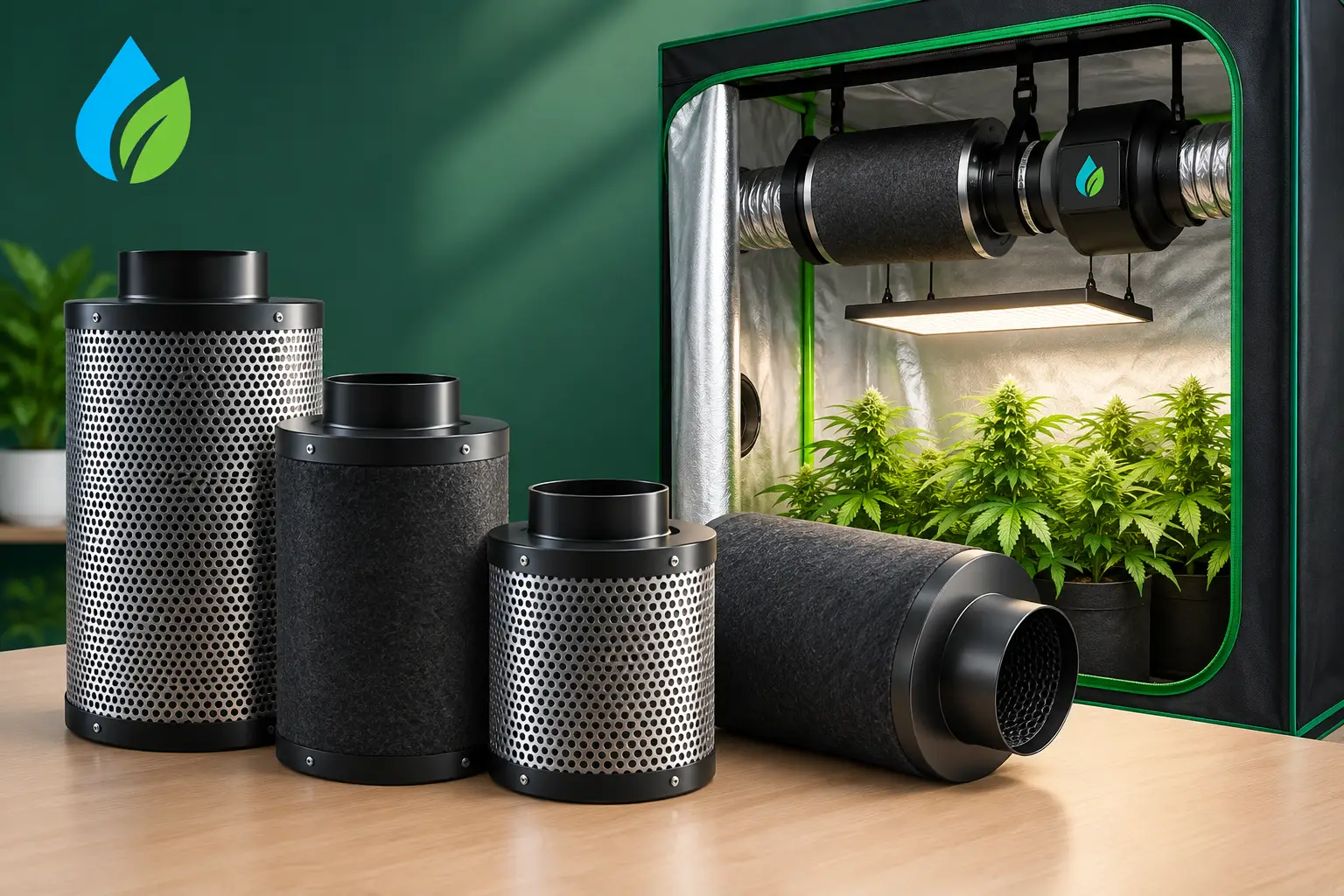
Choosing a Carbon Filter for a Grow Tent
A carbon filter for grow tent ventilation is not just an odour-control accessory. It is part of the system that keeps air moving, heat manageable and your growing space discreet. When the filter, fan and ducting are correctly matched, you get steadier environmental control without choking airflow – a practical foundation for healthier plants and more consistent yields.
The mistake many growers make is choosing a filter by tent size alone, then pairing it with whichever fan is available. Carbon filters create resistance, so the real question is whether your extraction fan can still move enough air once the filter and ducting are connected. Getting that balance right from the beginning saves you from noisy equipment, warm tents and disappointing filter performance.
What a carbon filter does in a grow tent
A carbon filter contains activated carbon, a highly porous material that traps odour molecules as air passes through it. In a tent setup, the extraction fan pulls warm, humid air through the filter and sends the treated air outside the tent through ducting. This helps manage odours before air leaves the growing area.
The filter also supports the wider ventilation system. Grow lights, pumps and plant transpiration all add heat and moisture to an enclosed tent. By continuously replacing that air, an extraction system helps maintain conditions that suit photosynthesis and reduces the chance of stagnant, humid pockets where fungal issues can develop.
A filter will not lower temperature by itself, and it cannot fix an undersized fan or poor intake airflow. Think of it as one component in a chain: fresh air enters the tent, air moves through the canopy, the fan extracts it through the filter, and ducting carries it away. Every part needs to suit the others.
Choosing the right carbon filter for a grow tent
Start with the fan, not the filter. Your fan’s airflow rating is usually measured in cubic metres per hour, or m³/h. As a simple starting point, calculate the volume of your tent by multiplying its length, width and height in metres. A 1.2 m x 1.2 m x 2 m tent has a volume of 2.88 m³.
In a basic setup, the air in that tent should be exchanged frequently. But a fan’s advertised free-air rating is not what it delivers once you add a carbon filter, ducting, bends and a duct outlet. These all reduce airflow. LED-lit tents may require less extraction than a high-heat lamp setup, while a warm Australian summer can demand considerably more.
As a practical rule, choose a fan with enough capacity to overcome system resistance while still allowing speed control. A slightly oversized fan running at a lower setting is often quieter and more effective than a small fan running flat out. Then select a carbon filter with a compatible duct diameter and an airflow rating equal to or above the fan’s working capacity.
Match the duct diameter
A 150 mm filter should generally be used with 150 mm fan and ducting. Reducing duct size with adaptors can restrict airflow, increase fan noise and make the whole system less efficient. The same applies to undersized ducting runs or crushed flexible duct.
Larger diameter systems can move more air at lower speed, which is useful in larger tents, hot spaces or grows where quiet operation matters. Smaller systems suit compact tents, provided the heat load is modest and the fan has enough pressure capability to work through the filter.
Check the filter length and carbon weight
Two filters can share the same diameter but perform differently. A longer filter generally contains more carbon and provides a larger surface area for air treatment. This can improve odour control and may last longer, particularly where the tent is in regular use or plants have a strong natural aroma.
That does not mean the biggest filter is always best. A long, heavy filter takes up valuable headroom and needs secure mounting. For a small tent with a modest fan, an oversized filter can be awkward without adding a meaningful benefit. Choose for your actual airflow, available space and expected run time.
Where to place the filter
Most growers install the carbon filter inside the tent, near the roof, with the extraction fan pulling air through it and pushing that air into ducting. Because warm air rises, this position captures the hottest air near the top of the tent before it builds up around lights and upper foliage.
This arrangement keeps odour treatment inside the enclosed space and maintains negative pressure. You can check negative pressure by looking at the tent walls when the extraction is running. They should draw in slightly, not balloon outward. A gentle inward pull suggests air is entering through the intended passive vents or intake points rather than escaping through gaps.
In some rooms, a filter can be positioned outside the tent and connected to a fan that pulls air out. This can free up headroom, but the tent, ducting connections and fan housing must be well sealed. If unfiltered air can leak before reaching the carbon, odour control will suffer.
Keep ducting as short and straight as practical. Every sharp bend adds resistance. If bends are necessary, use broad, gradual curves rather than tight kinks, and avoid running ducting where it can be crushed by equipment or pinched against a wall.
Installing it securely and safely
Carbon filters are heavier than they look. Hang the filter from the tent’s top support bars using quality ratchet straps or heavy-duty hangers rated for the load. Check the tent manufacturer’s stated load capacity, especially when the roof is already carrying an LED light, fan and other equipment.
Fit the pre-filter sleeve around the outside of the carbon filter before installation. This fabric layer catches dust, lint and loose debris so the carbon bed stays cleaner. Air should be pulled through the sleeve and filter, not blown out through it in a standard internal-tent setup.
Use clamps or appropriate duct connectors at every join. Foil tape can help seal small gaps, but it should not be relied on to support the weight of ducting. Keep electrical leads away from duct runs, avoid overloading power boards and make sure the fan is installed according to its instructions.
Balancing airflow, humidity and noise
A powerful fan is useful only if it is working for the environment, not against it. If extraction is too aggressive in a small tent, humidity can fall quickly and plants may transpire faster than expected. In cooler weather, excessive extraction can also make it difficult to maintain stable temperatures.
On the other hand, weak extraction allows heat and humidity to build up. This is especially common late in the growth cycle when foliage is dense, plants are drinking heavily and the tent has less open air space. A thermometer-hygrometer placed at canopy height gives a far more useful picture than judging conditions from outside the tent.
Fan speed controllers are valuable because they let you tune airflow as seasons and plant size change. A controller can also reduce noise, although fan hum often comes from vibration rather than speed alone. Suspend the fan where possible, keep ducting supported and avoid letting equipment touch tent poles or hard walls.
When to replace your carbon filter
A carbon filter does not last forever. Lifespan depends on carbon quality, fan speed, humidity, dust levels and the amount of air treated. In many home setups, a quality filter may last one or more growing cycles, but there is no fixed replacement date that suits every tent.
The clearest sign is odour escaping while the fan is running and the system is otherwise sealed. Before replacing the filter, check the basics: confirm the fan is pulling in the correct direction, inspect ducting for leaks, make sure the pre-filter is clean and check that the fan is still operating properly.
High humidity can shorten a filter’s effective life because moisture occupies space within the carbon. Regularly cleaning or replacing the outer pre-filter sleeve helps reduce dust loading, but washing the activated carbon itself is not a solution. Once the carbon is saturated or no longer controlling odours, replace the filter.
A setup that supports better growing
The best carbon filter setup is usually the one you barely notice. It runs quietly, keeps the tent under slight negative pressure and gives your plants a steady supply of fresh air without dramatic swings in temperature or humidity. Match the filter to a capable fan, use the correct duct size and leave room to adjust as the weather changes.
If you are unsure whether your fan, filter and tent are properly matched, bring the dimensions of your space and details of your lighting to Hunter Hydro. A few accurate measurements can turn ventilation from a guessing game into a reliable part of bigger yields made simple.