A grow tent can look perfectly dialled in – bright light, healthy feed, tidy canopy – yet still produce slow growth or fungal problems because the air is out of balance. Relative humidity, usually shown as RH, affects how readily plants move water and nutrients from the root zone to their leaves. Get it close to the mark and plants transpire steadily. Let it run too high or too low, and even a good nutrient program can underperform.
This grow tent humidity guide gives you practical targets, explains what causes humidity swings, and shows how to correct them without chasing your tail. The goal is not a single magic number. It is a stable environment that suits your plant’s growth stage, temperature, airflow and canopy density.
Why humidity matters in a grow tent
Humidity is the amount of water vapour in the air. Relative humidity compares that moisture with the maximum amount the air can hold at its current temperature. Warm air holds more moisture than cool air, which is why a tent can show a different RH reading when lights switch off, even if no water has been added.
Plants release water vapour through tiny leaf openings called stomata. This process, known as transpiration, helps pull water and dissolved nutrients up from the root zone. When the surrounding air is excessively dry, plants can transpire too fast, leading to stressed leaf edges, rapid drying and unnecessary demand on the roots. When the air is too humid, transpiration slows, nutrient movement can become less efficient, and moisture can settle within dense foliage.
High humidity also gives fungal diseases and mould a better chance to establish, particularly when air movement is poor. In a compact tent, it is usually better to prevent these conditions than to try to rescue a crowded, damp crop later.
Grow tent humidity guide: RH targets by growth stage
The best RH depends on plant type, temperature and how established the root system is. These ranges are reliable starting points for many indoor food, herb and ornamental crops. Use them as a guide, then watch how your plants respond.
Propagation and seedlings: 65-75% RH
Fresh cuttings and young seedlings have limited roots, so they can struggle to replace water lost through their leaves. A higher humidity level reduces that stress while roots form. Propagation domes can help, but they should not stay sealed and dripping with condensation. Open vents gradually or lift the dome for short periods so young plants acclimatise to normal tent conditions.
Keep gentle airflow nearby rather than directing a fan at delicate seedlings. Stagnant, saturated air can encourage damping-off and other disease issues before plants have a chance to establish.
Vegetative growth: 55-70% RH
Once roots are actively working, most plants are comfortable at a moderately humid setting. This supports leaf development and vigorous growth without creating an overly damp canopy. Larger plants use more water, so humidity will often climb soon after watering or when the lights come on.
If leaves are healthy, upright and growing steadily, there is no need to chase minor hourly changes. Stability matters more than making every reading exact.
Flowering and fruiting: 40-55% RH
As plants become denser and develop flowers or fruit, lower humidity is generally safer. Moisture can become trapped around tightly packed growth, especially overnight when temperatures fall. Aim towards the lower end of the range in a full tent with a thick canopy, but avoid making the room excessively dry if plants are showing stress.
A grower running a sparse canopy in warm conditions may be fine around 55% RH. A grower with closely spaced plants, large leaves and heavy flowering sites may need to maintain closer to 40-45%, supported by good extraction and circulation.
Temperature changes the reading and the risk
RH cannot be managed separately from temperature. When lights turn off, air cools and RH rises. This is often the highest-risk part of the day because the tent may remain humid for hours while foliage is cooler and airflow is reduced.
For many indoor gardens, keeping day and night temperatures reasonably close makes humidity easier to control. A dramatic temperature drop after lights off can produce condensation on tent walls, ducting and leaves. If you see moisture on surfaces, treat it as a warning that the environment needs attention.
Rather than relying on a basic thermometer alone, use a digital hygrometer that records minimum and maximum readings. A unit with a remote probe or data logging function is even more useful in larger tents because it reveals what happens when you are not standing in front of the setup.
The equipment that controls humidity
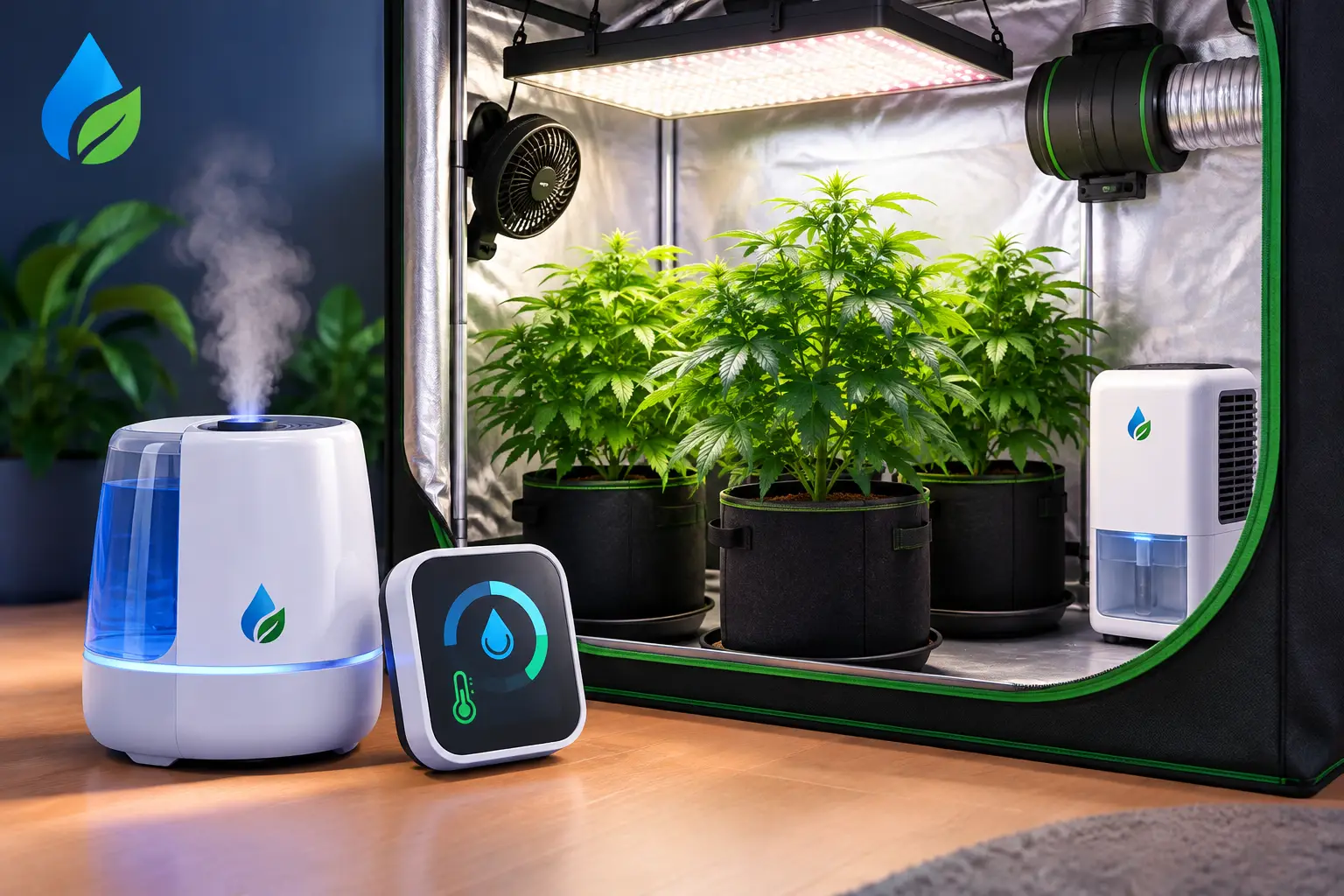
Humidity control starts with correct ventilation. Your extraction fan should remove warm, moist air from the top of the tent, where humidity and heat naturally collect. Fresh air then enters through passive vents or an appropriately sized intake. If the tent walls pull in slightly while the fan is running, you usually have useful negative pressure and air is moving through the space.
Fan capacity must suit the tent size, lighting heat and length of ducting. Long duct runs, tight bends and carbon filters all reduce effective airflow. A fan that looks adequate on paper can fall short once it is connected to real-world equipment. Using properly sized ducting, keeping runs short where possible and avoiding crushed flex duct helps preserve performance.
An oscillating circulation fan is equally valuable, but it has a different job. Extraction replaces humid air. Circulation prevents still, wet pockets inside the canopy. Position fans so leaves move gently and air reaches under and through the plant structure. Constant strong wind on one spot can cause wind stress, so adjust the fan height and angle as plants grow.
When extraction alone cannot keep RH down, a dehumidifier may be the right solution. Place it in the lung room outside the tent where possible, especially if space inside is limited. A dehumidifier adds heat, so monitor temperature after installation and consider a controller that coordinates fan speed, heaters and dehumidification.
If humidity is too low, a humidifier can help during propagation or in dry winter conditions. Use clean water, clean the unit regularly, and avoid placing mist directly onto leaves or electrical equipment. In hydroponic spaces, hygiene is part of environmental control.
Practical ways to reduce high humidity
Start by identifying when and why RH rises. A tent that spikes after watering needs a different adjustment from one that stays damp all night. Check your reservoir, trays and floor for standing water. Cover open reservoirs where practical, repair leaks, and remove runoff rather than allowing it to evaporate inside the tent.
Plant spacing also matters. An overfilled tent may deliver more plants, but it often produces a humid, shaded centre where airflow cannot reach. Selective leaf removal and sensible training can improve airflow, light penetration and access for inspections. Do not strip plants aggressively simply because humidity is high. Remove crowded, damaged or poorly lit growth with a clear purpose.
For persistent lights-off spikes, increase extraction during the dark period, run a dehumidifier in the surrounding room, or adjust the lighting schedule so lights operate during the cooler, more humid part of the day or night. The best option depends on your household conditions, power costs and available equipment.
Signs your humidity needs adjustment
Plants do not always announce a humidity issue with one obvious symptom. Look for a pattern. Leaves that feel limp despite a suitably moist root zone may point to very dry air or excessive heat. Slow growth, soft lush foliage and persistent condensation can indicate too much humidity. Brown leaf tips may have several causes, including nutrient strength, pH and root-zone problems, so do not blame RH without checking the basics.
Inspect the inside of dense foliage regularly. A clean-looking outer canopy can hide yellowing leaves, poor airflow and early fungal issues deeper in the plant. Good environmental management works alongside sensible watering, accurate pH and EC measurements, and a nutrient strength that matches the crop and growth stage.
A simple daily humidity routine
Check RH and temperature at least once with lights on and once shortly after lights off. Record the readings for a week when you first set up a tent or make a major equipment change. That small habit quickly shows whether the issue is a brief spike, a nighttime problem or a constant lack of fresh air.
Avoid changing three things at once. If you raise fan speed, change the lighting schedule and add a dehumidifier on the same day, you will not know what solved the issue. Make one practical adjustment, give the tent time to settle, and review the result.
Every tent, climate and crop has its own balance. If you are unsure whether you need a larger extraction fan, better circulation, a controller or a dehumidifier, Hunter Hydro can help match the gear to your tent size and growing conditions. Small environmental improvements often show up as healthier plants, cleaner foliage and more consistent harvests.