GT Optimum Feeding Guide: Grow & Bloom Chart, pH, EC and Tank Calculator
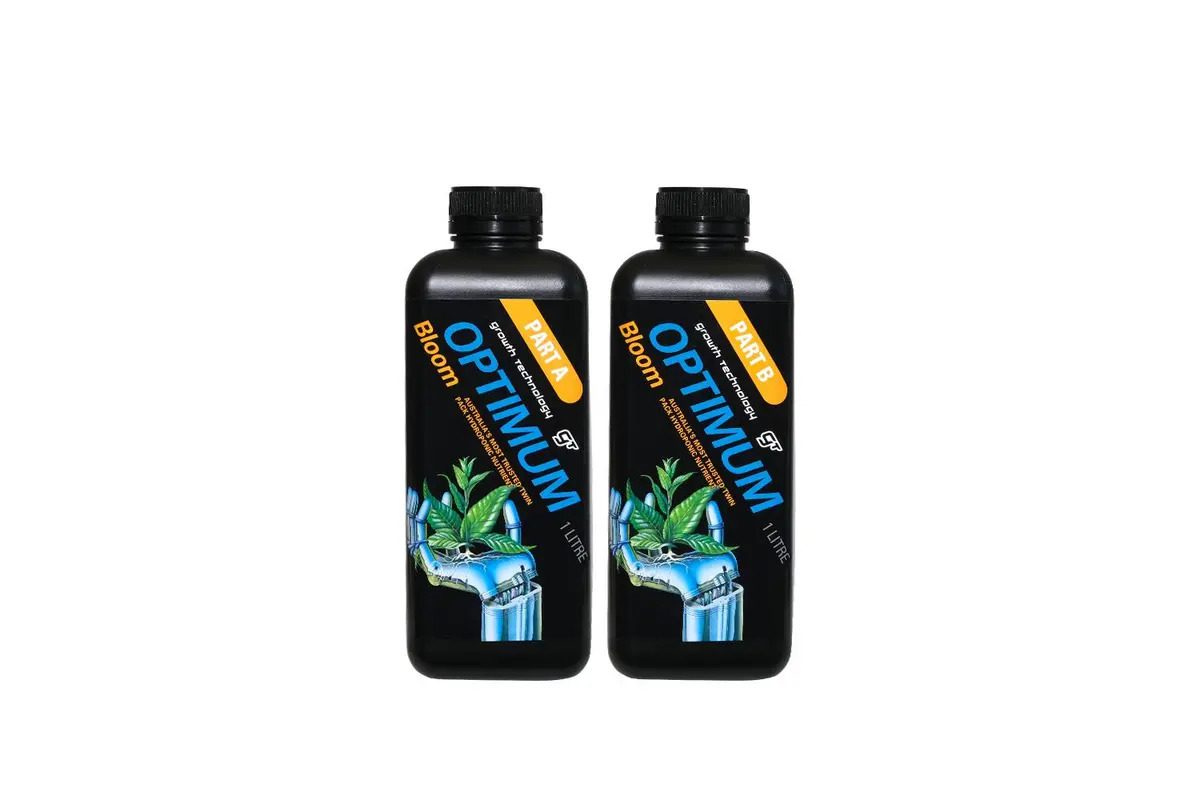
Growth Technology Optimum is a two-part hydroponic nutrient range. Use Optimum Grow A+B for vegetative growth and Optimum Bloom A+B for flowering and fruiting. This guide covers feed strength, correct mixing, Super PK timing and quantities for your tank.
Quick answer: Optimum Grow uses 3–4 mL of A and 3–4 mL of B per litre of water. Optimum Bloom uses 4 mL of A and 4 mL of B per litre. Keep matching A and B equal, adjust strength to the required EC, and adjust pH last to 5.5–6.5. These are fresh-batch label rates, not automatic top-up doses.

How to mix GT Optimum nutrients in the right order
- Measure the water for a fresh batch in a clean tank and record its starting EC.
- Optional silica: if choosing GT Silica, mix it into plain water first, following its current label and resting instructions. Skip this step when not using silica.
- Add Optimum Grow A or Optimum Bloom A to the water. Stir thoroughly.
- Add an equal volume of the matching Part B. Stir again. Never mix A and B concentrates together.
- Add any other chosen additives separately according to their labels.
- Measure EC. Dilute if too strong; make small, equal A+B adjustments if more feed is needed.
- After thorough mixing, measure and adjust pH to 5.5–6.5. A starting point near 6.0 sits within this range.
Use separate measuring equipment or rinse between concentrates. Follow the handling precautions on nutrients and pH adjusters.
GT Optimum feeding chart by growth stage
All A+B rates are for each part separately. Use the growth-stage EC and pH targets below and measure the finished solution, including Super PK and any other additives. Adjust the equal A+B dose to reach the required EC.
| Stage | Nutrient | Part A (mL/L) | Part B (mL/L) | Super PK (mL/L) | Finished EC (mS/cm) | pH target |
|---|---|---|---|---|---|---|
| Vegetative growth | Optimum Grow | 3–4 | 3–4 | — | 1.5–2.0 | 5.8–6.2 |
| Flowering weeks 1–2 | Optimum Bloom | 4 | 4 | — | 2.0–2.5 | 6.0–6.5 |
| Flowering week 3 | Optimum Bloom | 4 | 4 | 1 | 2.0–2.5 | 6.0–6.5 |
| Flowering weeks 4–5 | Optimum Bloom | 4 | 4 | 2 | 2.0–2.5 | 6.0–6.5 |
| Flowering week 6 | Optimum Bloom | 4 | 4 | 1 | 2.0–2.5 | 6.0–6.5 |
| Flowering weeks 7–8 | Optimum Bloom | 4 | 4 | — | 2.0–2.5 | 6.0–6.5 |
Silica is optional. It is separate from the base nutrient and excluded from these base-feed rates. Young plants and sensitive crops may need a weaker solution; obtain crop-specific advice rather than assuming the full label rate suits propagation.
GT Super PK — start in flowering week 3
Super PK supplies extra phosphorus and potassium during bloom. Begin in flowering week 3: 1 mL/L in week 3, 2 mL/L in weeks 4–5, 1 mL/L in week 6, then omit it in weeks 7–8.
Add Super PK after Bloom A and B have been mixed separately into water. Keep the finished feed within the flowering EC target. GT gives a general Super PK dose range of 1–3 mL/L and a maximum of 5 mL/L; use the stage amounts in the chart below for this feeding programme.
Add Super PK after mixing Bloom A and B separately into water. Stir, measure the combined EC and adjust pH last. Do not automatically repeat full-tank Super PK doses when topping up a retained reservoir.
GT Optimum tank calculator — A and B in millilitres
Enter the litres of new water being mixed into a fresh batch. This calculator is not a prescription for adding nutrients to an existing reservoir. It lists A and B separately.
GT’s hydroponic silica article gives 5 mL/L. Only select this if appropriate to your product label and fresh-mixing routine. Leave it off for a retained reservoir or ordinary top-up.
20 L at 3 mL/L: 60 mL Grow A and 60 mL Grow B. Optional silica: not selected.
If the calculator is unavailable: litres × mL/L = millilitres of each part. A 50 L fresh batch at 4 mL/L needs 200 mL A and 200 mL B. Always measure the finished EC and pH.
Want a printable chart for your own tank size? Use the Hunter Hydro personalised GT Optimum feed chart to enter your litres, calculate each stage, and download, print or save the result as a PDF.
What pH and EC should GT Optimum be?
Vegetative: EC 1.5–2.0 mS/cm, pH 5.8–6.2. Flowering: EC 2.0–2.5 mS/cm, pH 6.0–6.5. These are the stage targets in the published Optimum chart. Measure after all additives are mixed, and dilute if the finished feed is too strong.
The manufacturer’s range is pH 5.5–6.5 for both Grow and Bloom. Test after the nutrients and selected additives have been mixed. Check your meter with fresh calibration buffers before making large corrections to an unexpected reading.
pH describes acidity or alkalinity. EC measures electrical conductivity and helps track total dissolved salts; it does not reveal the remaining amount of every individual nutrient. Record starting water EC and finished feed EC in mS/cm. The same mL/L rate can produce different results with different source water.
Optional silica and reservoirs that are topped up
You do not need to include silica to follow the Optimum A+B programme. Many growers retain their reservoir between top-ups, so the guide and calculator leave silica optional and switched off by default.
Growth Technology’s silica guidance says to mix fresh and use promptly. When selected for a suitable fresh batch, add it to plain water before nutrients and follow the current bottle’s resting times. Do not pour concentrated silica into an established nutrient tank, or automatically repeat a full-reservoir dose every week.
How to top up an existing reservoir
- Record the remaining volume, EC and pH before adding anything.
- Restore the water level, circulate thoroughly, then recheck EC.
- If feed strength needs increasing, prepare a diluted adjustment separately with matching A and B in equal amounts, add gradually and retest.
- Adjust pH after the reservoir is fully mixed. Record what was added.
For example, a 100 L reservoir that has fallen to 80 L does not need another 100 L recipe. Even dosing the missing 20 L at full strength without testing may add too much: water loss and nutrient uptake are different processes. Do not calculate silica replacement from EC.
Topping up indefinitely can allow nutrient imbalance even when EC appears normal. Follow the manufacturer’s reservoir-management advice for your crop and system, and plan complete changes as appropriate. Optional silica does not remove the need to monitor or renew nutrient solution.
Choosing the right growing setup
Optimum is suited to hydroponic growing, including systems using clay pebbles, perlite or rockwool. In recirculating systems, maintain reliable irrigation, clean pumps and filters, and appropriate root-zone oxygenation.
Shop GT Optimum at Hunter Hydro
Ask Hunter Hydro for Optimum Grow A+B for vegetative plants and Optimum Bloom A+B for flowering and fruiting. Check the GT nutrients range for available products and sizes. Bring your tank size, medium and water readings so we can help you select the right programme.
Related guides: pH meter calibration, understanding EC meters and choosing hydroponic nutrients.
Manufacturer directions and printable guide
Product instructions: GT Optimum Grow, GT Optimum Bloom, GT Super PK and GT Silica. Reference charts: Optimum EC and pH chart and GT feeding guide supplied with the Optimum listing. Generate your personalised chart above to print or save your tank quantities.
GT Optimum frequently asked questions
Does 4 mL/L mean 2 mL A and 2 mL B?
No. At 4 mL/L of each part, use 4 mL A plus 4 mL B for every litre of water.
How much do I add to 20 litres?
Grow at 3 mL/L uses 60 mL A and 60 mL B. At 4 mL/L, use 80 mL A and 80 mL B. Bloom’s label rate gives 80 mL A and 80 mL B. Check EC before feeding.
Is silica compulsory?
No. It is an optional additive. The base calculator works with silica off, and fresh-batch silica amounts must not be used as automatic reservoir top-up doses.
Do I change from Grow to Bloom on a fixed week?
Use the plant’s growth stage and crop programme: Grow for vegetative development, Bloom for flowering and fruiting.
Can I just top up and check EC forever?
EC cannot show individual nutrient balance. Keep a reservoir log and renew solution according to the manufacturer’s advice for your system.