
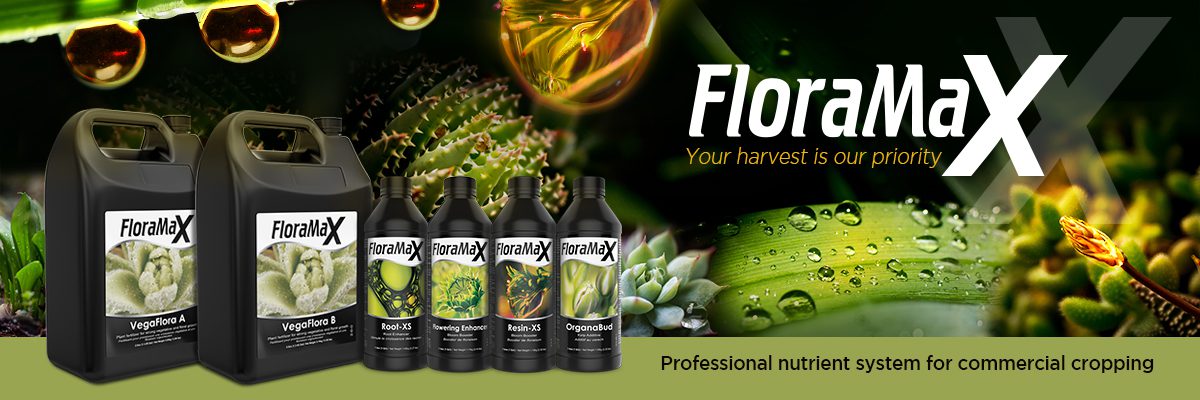
Choosing a nutrient range is easier when you understand what each product contributes. FloraMax nutrients give Australian growers a choice of liquid nutrients and concentrated ProPowders, supported by feeding charts for hydroponics, coco and soil. This guide explains the base nutrients, the core additives and the supporting products listed by Australian retailers, with links to the manufacturer’s current resources.
The practical starting point is to choose one base nutrient, select its matching feed chart and build the program around your crop, water and irrigation system. Australian market availability does not mean every product or pack size is currently stocked at Hunter Hydro. Contact our team to check the range before ordering.
What makes FloraMax different?
FloraMax’s manufacturer describes a chemistry-led approach combining mineral nutrition with purified organic components in selected products. Its emphasis is on soluble feeds suitable for reservoirs, drippers and automatic dosing, alongside additives intended to support particular stages of growth. These are manufacturer-described benefits; results still depend on the crop and growing conditions. Explore FloraMax’s formulation approach.
For the grower, the useful questions are concrete: how many parts need measuring, how easy is the product to dissolve, which stages require it, and how much storage space does it take? A nutrient program should make those decisions clearer. Good lighting, dependable irrigation and a healthy root zone remain essential.
Liquid nutrients or ProPowders?
| Consideration | Liquid | ProPowder |
|---|---|---|
| Measuring | Measure the specified millilitres. | Weigh the specified grams accurately. |
| Preparation | Dilute each product into water. | Dose dry into water or prepare a stock solution using the product’s instructions. |
| Handling | Convenient for small batches and growers who prefer measuring liquids. | Compact for freight, storage and larger batch preparation. |
| Dose units | mL/L of working feed. | g/L when dosing dry; mL/L only for correctly prepared stock. |
| Range | Includes bases, additives and specialist supporting products. | Six product families verified in Australian listings below. |
FloraMax says its ProPowders dissolve in minutes, including in cold or hard water. Dry dosing, liquid stock and certain manufacturer-specified premixes are supported. Powders must be weighed rather than measured with teaspoons. A bag described as making “1L” makes stock concentrate, not just one litre of finished feed. Never substitute a liquid dose for the same numerical amount of powder. Read the ProPowder directions.
Choose one base: Veg-1 or VegaFlora A+B
Veg-1: a single-part base for both veg and bloom
Despite its name, Veg-1 is used from seed to harvest. It is available as a liquid and a ProPowder, and the manufacturer specifies it for hydro, coco and soil. The main convenience is measuring one base product instead of separate A and B parts or changing between grow and bloom bases. FloraMax says its recommended program generally removes the need for a separate cal-mag supplement, including with reverse-osmosis water.
Veg-1 remains the base while the additive schedule changes with growth stage. It should not be mistaken for a complete five-product feeding program in one bottle. Veg-1 specifications.
VegaFlora A+B: a two-part liquid base
VegaFlora uses the same A+B formulation through vegetative growth and flowering. It is the liquid option for growers who prefer a two-part base, including automatic dosing arrangements. Manufacturer benefits include chelated trace elements, solubility and improved reservoir and pH stability.
Read the A and B columns separately: a chart specifying 2mL/L of A and 2mL/L of B requires both amounts. Keep the concentrates separate and dilute each into the mixing water. The verified Australian range includes liquid A+B; this guide does not list a VegaFlora powder. VegaFlora specifications.
The four core additives
Root-XS: roots and establishment
Root-XS is formulated to support root development and reduce transplant stress. Current manufacturer directions use it throughout veg and during flowering weeks 1–3. Liquid and ProPowder versions are listed in Australia. The manufacturer also describes foliar use, which should follow the relevant application directions. Adequate pot space and even irrigation are still important; a root additive cannot correct a root-bound plant. Root-XS directions.
OrganaBud: plant structure and fruit quality
OrganaBud is the structure and quality additive in the program. FloraMax describes benefits for branching, flower-site development and aromatic crop quality. Its purified organic formulation is intended to avoid the foaming and deposits associated with some raw organic inputs. Both liquid and ProPowder versions are listed locally. Current directions run from seed to harvest, with higher rates restricted to specified flowering weeks. OrganaBud directions.
Flowering Enhancer: PK, calcium, magnesium, iron and pH support
Flowering Enhancer combines phosphorus and potassium with calcium, magnesium and iron, plus a formulation intended to improve pH stability. Its practical benefit is consolidating several flowering functions into one additive. Both formats are listed in Australia. Use it during flowering according to the chosen chart. Extra cal-mag and another PK booster should not be automatic additions to this program. Improved pH stability also does not remove the need to check pH. Flowering Enhancer specifications.
Resin-XS: mid-to-late flowering
Resin-XS is positioned as a late-flowering quality and mass additive, with manufacturer claims concerning fruit density, resin and aromatic development. FloraMax identifies it as PGR-free. Liquid and ProPowder versions are listed locally. Current product directions generally start it in flowering week 4; standalone use in another nutrient program has different directions. Follow one coherent schedule rather than combining the FloraMax program with extra finishers or PK boosters. Resin-XS directions.
Supporting products available in Australia
Ca-Mg-Fe: targeted supplementation
Ca-Mg-Fe supplies calcium, magnesium, iron and additional trace nutrients, rather than calcium and magnesium alone. Both liquid and powder are listed in Australia. It is an as-required supplement, not a mandatory extra bottle for every FloraMax grow. The manufacturer says the bases and Flowering Enhancer already provide sufficient cal-mag when the feeding program is adequate. Check water, pH, feed delivery and root conditions before assuming a discoloured leaf needs more supplement. Ca-Mg-Fe specifications.
Growth-XS: a short early-veg application
Growth-XS is a liquid vegetative additive intended to accelerate early development. FloraMax describes shorter veg periods, but the improvement should not be treated as a guaranteed number of weeks or extra annual crops. Current directions generally apply it during veg week 2, or week 1 for a shorter veg phase. Do not use it during flowering or the final week of veg. It is a targeted application rather than a product added continuously. Growth-XS directions.
Silica: structural support
FloraMax Silica is a concentrated liquid silicon supplement. The manufacturer describes benefits for stem and leaf rigidity and tolerance of heat-related wilt. Its low application rate makes accurate measuring important. The product directions require at least tenfold predilution with water before adding it to the nutrient solution. A foliar rate is a separate application and must not be substituted for the reservoir rate. Silica directions.
System Maintenance: keeping feed delivery clear
System Maintenance is the liquid option intended to reduce deposits and blocked drippers, pumps and filters. FloraMax describes compatibility with organic additives and beneficial organisms, while warning against concurrent chlorine or peroxide use. Its purpose is reliable feed delivery; it does not replace inspecting filters, checking every dripper and cleaning equipment between crops. Nutrient-solution and post-harvest cleaning rates differ. System Maintenance directions.
Pythoff PLUS: water and system conditioning
Pythoff PLUS is listed by Australian retailers for water conditioning and system cleanup. It is distinct from System Maintenance. Its manufacturer page warns against use with beneficial bacteria, live systems, hydrogen peroxide and hypochlorous acid. Current organic-additive pages also warn against chlorine and peroxide. Obtain FloraMax’s confirmed compatibility instructions for the exact program before combining treatments; do not assume an older chart settles compatibility. Pythoff PLUS directions.
Clone Spray and Cloner: propagation products
Australian listings include Clone Spray, a foliar product for propagation, and Cloner, a cloning gel. They serve different jobs from the base nutrients and should be used according to their labels. FloraMax’s Growers Guide describes their roles in establishing cuttings. A gel is not a reservoir nutrient, and a foliar application should not be copied into a root-feed recipe. Read the manufacturer’s propagation guide.
Australian liquid and powder availability
The following product families were cross-checked against Australian retail listings. They describe the Australian market, rather than a promise of immediate Hunter Hydro stock. Pack sizes and availability can change.
| Product | Liquid or other format | ProPowder |
|---|---|---|
| Veg-1 | Liquid | Yes |
| VegaFlora A+B | Two-part liquid | Not featured |
| Root-XS | Liquid | Yes |
| OrganaBud | Liquid | Yes |
| Flowering Enhancer | Liquid | Yes |
| Resin-XS | Liquid | Yes |
| Ca-Mg-Fe | Liquid | Yes |
| Growth-XS | Liquid | Not featured |
| Silica | Liquid | Not featured |
| System Maintenance | Liquid | Not featured |
| Pythoff PLUS | Liquid | Not featured |
| Clone Spray | Foliar liquid | Not featured |
| Cloner | Cloning gel | Not featured |
Our team can help you check which FloraMax products and pack sizes are available through Hunter Hydro.
Find the right digital feed chart
Use metric resources for Australian mixing: litres, millilitres and grams. The manufacturer’s feed-chart page currently links to the following PDFs uploaded in September 2026. Check the live resource page before each new run because links and revisions can change.
- Veg-1 and ProPowder metric feeding resource.
- VegaFlora A+B metric feeding resource.
- Official feed-chart page.
- FloraMax dosage calculator.
The calculator asks for system type, feed style, reservoir volume and water EC. Choose the appropriate setup and use a freshly calibrated meter. A downloaded schedule is more useful than copying isolated rates from a retailer description. For mixed liquid-and-powder programs, use the corresponding rate for each format rather than adding both full doses. Create a customised schedule.
Mixing without confusing concentrate and working feed
Keep a written batch recipe with product names, formats, water volume and units. This is especially useful if more than one person prepares feed. Record the actual water volume rather than the reservoir’s nominal capacity.
- Select the chart that matches the base, format and system. Check the current labels and compatibility directions.
- Fill the mixing vessel with the required water. Measure the starting water and use the chart’s preparation order.
- Measure each liquid or weigh each powder. Dilute and stir as instructed before the next addition.
- Predilute Silica as directed. Keep liquid concentrates apart; only use dry premixes or combined stocks explicitly covered by FloraMax’s instructions.
- Check the finished feed and record the batch. Monitor plant response and delivery through the system.
For arithmetic, a chart rate of 2mL/L in 50L requires 100mL; a powder rate of 0.1g/L in 50L requires 5g. These are calculation examples, not a feeding prescription. The chosen chart determines whether those rates apply to your product and stage.
pH, EC and runoff: the checks that protect your crop
Hydroponic nutrients only work when roots can absorb them. pH has a major influence on that process. For many hydroponic and coco-based gardens, a root-zone pH around 5.5 to 6.5 gives broad nutrient availability, although the ideal point can shift slightly with crop type, substrate and system.
Use a properly calibrated pH meter rather than relying on guesswork. Calibration solutions, clean probes and correct storage all matter. A meter that has dried out or drifted out of calibration can send you chasing nutrient deficiencies that are actually measurement errors.
EC should be measured at the reservoir, but runoff tells another part of the story for coco and other drain-to-waste media. Check the EC and pH of occasional runoff to see what is happening around the roots. Rising runoff EC often means the medium is concentrating salts. In that case, more frequent irrigation with an appropriate feed, or a planned reduction in concentration, may be more useful than adding another supplement.
Recirculating systems need close attention too. As plants drink water, the reservoir can change in both EC and pH. Top up with water or nutrient solution according to what the readings and plant behaviour indicate, and replace the reservoir solution regularly to avoid an increasingly unbalanced mix.
Common questions
Do I need separate grow and bloom base nutrients?
FloraMax’s Veg-1 and VegaFlora A+B each cover both stages. Choose one base and change its dose and additive schedule according to the manufacturer’s program.
Can liquid and powder be used in the same feed?
FloraMax permits format substitutions in diluted working feed using the appropriate chart rates. That does not authorise mixing concentrated products together or doubling a product’s dose.
Does “contains organics” mean certified organic?
A statement about organic ingredients does not establish certification of the whole range. Check certification documentation for the exact product if it matters to your production requirements.
Will extra bottles always improve results?
Start with the selected program. Additional supplements need a specific purpose. If growth stalls, check measurements, water delivery, roots and environment before changing the recipe.
How should I compare cost?
Compare the cost of the complete program at its prescribed doses, not just the price of a bottle or bag. Include the water volume you use and any freight or preparation costs. A powder’s stock-volume equivalent is not its finished-feed volume.
Build a program suited to your garden
Bring Hunter Hydro your growing medium, irrigation method, reservoir volume and starting water readings. Our team can help you work through the Australian FloraMax options and check availability. We serve growers across Newcastle and the Hunter Valley.
Related guides: choosing hydroponic nutrients, calibrating a pH meter, understanding EC meters and cleaning a reservoir.
Research checked 7 October 2026. Product benefits and application details are attributed to FloraMax. Consult current labels and manufacturer advice for your setup.