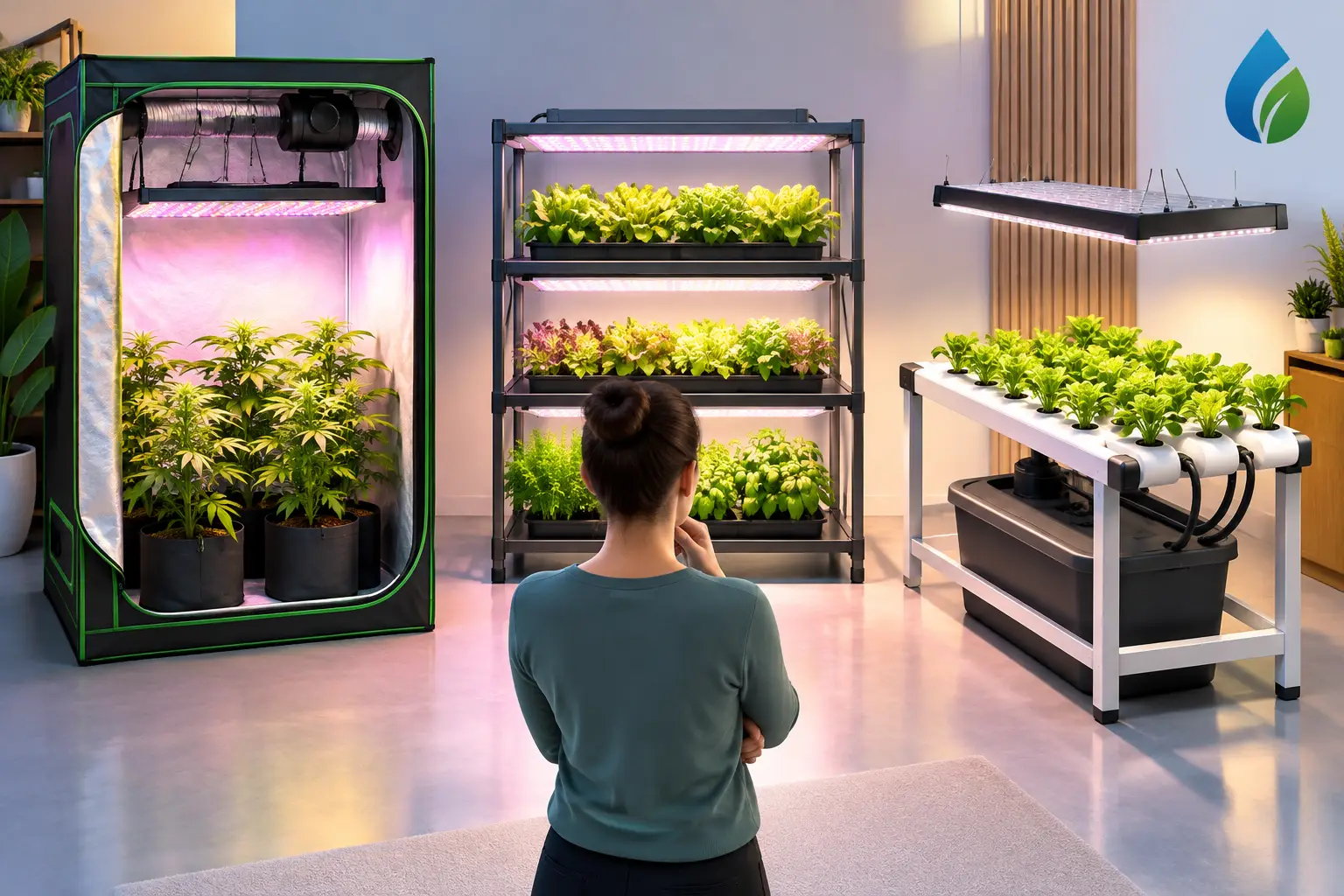
A light that looks bright to your eyes can still leave plants stretching, underperforming or developing unevenly. LED grow lights give indoor and greenhouse growers far more control over plant growth, but choosing one is not simply a matter of buying the highest wattage fixture you can fit above the canopy. The best result comes from matching the light to your growing area, plant type, growth stage and the rest of your environment.
For a small propagation shelf, a compact full-spectrum fixture may be exactly right. For a productive tent or a greenhouse supplementing winter sunlight, you may need a higher-output bar light, better canopy coverage and more attention to heat, airflow and electrical safety. Bigger yields are made simple when each part of the setup works together.
What LED grow lights do for plant growth
Plants use particular wavelengths of light to drive photosynthesis. A quality LED fixture delivers useful plant light efficiently, with a spectrum designed to support healthy vegetative growth, flowering and fruiting. Compared with older HID lighting, LEDs generally produce less radiant heat, use less power for a comparable level of usable light and can be positioned closer to the canopy in many setups.
That does not mean every LED is the same. The diodes, driver, fixture design and optical layout all affect how evenly light reaches your plants. A cheap light may have an impressive-looking wattage claim but poor coverage, unreliable output or a spectrum that does not suit full-cycle cultivation. It is worth looking beyond the marketing label.
For most home growers, a full-spectrum white LED is a practical starting point. It provides broad light across the visible range and makes it easier to assess leaf colour, nutrient issues and pest activity while working in the grow space. Some fixtures also add deep red or far-red diodes. These can be useful in the right application, but they are not a shortcut around good nutrition, watering and environmental control.
How to choose LED grow lights for your space
Start with the dimensions of the actual canopy, not the size of the room. A light needs to cover the leaves that will be producing growth, and its usable footprint changes with hanging height. A fixture suited to a 60 cm by 60 cm tent will not automatically perform well across a 1.2 m by 1.2 m canopy, even if you hang it higher. Raising a light expands its spread but reduces intensity at the plant surface.
The next question is what you are growing and how hard you want to push production. Leafy greens, herbs, cuttings and young plants can thrive under lower light levels. Fruiting plants and plants in a high-demand flowering stage need more intensity and a more even canopy. If the plants are spread across multiple shelves or benches, several smaller fixtures may provide better coverage and flexibility than one powerful light in the middle.
Do not choose by wattage alone
Wattage tells you how much electricity a fixture draws from the wall. It helps you estimate running costs, but it does not tell the full story about plant performance. Two 300-watt fixtures can deliver very different light levels at the canopy.
PPF and PPFD are more useful terms to understand. PPF measures the total amount of plant-usable light a fixture emits each second. PPFD measures how much of that light reaches a square metre of canopy each second, expressed in micromoles per square metre per second. PPFD is the number that matters most at leaf level, because it shows what the plant actually receives.
Ask whether a fixture has a realistic PPFD map at a stated hanging height and coverage area. The centre reading should not be the only figure you consider. A useful map shows whether the edges receive enough light too. Even coverage helps create an even canopy, which makes watering, feeding and training easier across the whole grow.
Match intensity to the growth stage
Seedlings and fresh cuttings need gentle light while roots establish. Too much intensity too soon can slow them down, causing pale new growth, curling leaves or stress that looks like a nutrient problem. Begin with the light higher above the plants or run a dimmable fixture at a lower setting, then increase output gradually as the plants develop.
Vegetative plants generally respond well to stronger light, provided root-zone health, nutrition and airflow keep pace. At flowering or fruiting, plants often have their greatest light demand. This is where an undersized fixture can limit yield, particularly around the edges of the canopy.
DLI, or daily light integral, adds another useful layer. It describes the total light a plant receives across the day, combining PPFD and photoperiod. A moderate PPFD run for a longer period can sometimes suit low-light plants, while high-light crops may need a stronger fixture and a carefully managed day length. More light is only helpful when temperature, carbon dioxide availability, water and nutrients are also adequate.
Hanging height, dimming and the plant response
Treat the manufacturer’s hanging recommendation as a starting point, then let the plants guide the final adjustment. Watch the newest leaves closely. Leaves that angle sharply upwards, bleach at the top, curl at the edges or develop dry patches may be receiving more light or heat than they can use. Long internodes and plants leaning hard towards the fixture can indicate that intensity is too low.
A dimmer is one of the most useful features on an LED. It lets you buy enough output for later growth stages without overwhelming young plants at the beginning. It also gives you a simple way to respond when the weather changes, the canopy fills out or a plant is recovering from transplant stress.
Keep the canopy level where possible. Taller plants receive disproportionately more intensity when they are closer to the light, while shorter plants become shaded. Gentle training, plant risers or separating plants by height can improve uniformity without changing the entire setup.
Light is only one part of the environment
LEDs run cooler than many older systems, but they still create heat in a tent, cupboard or enclosed grow room. The fixture’s driver and diodes release heat into the surrounding air, and dense foliage can trap humidity underneath the canopy. A good extraction fan, fresh-air intake and circulating fan protect plant health as light levels rise.
Temperature and humidity affect how well a plant can use the light you provide. If the room is too hot, too humid or stagnant, plants may transpire poorly and become more susceptible to fungal problems. If it is too cold, growth can slow even under an excellent fixture. Position fans to move air around and through the canopy rather than blasting one section of leaves constantly.
Nutrient management matters here too. Faster growth under stronger lighting increases demand for water and nutrients, but it does not mean doubling feed strength. Monitor pH and EC regularly, especially in recirculating hydroponic systems. A healthy root zone gives plants the foundation to make the most of their light.
Plan the practical details before installation
Measure your tent or growing area, allow room for ratchet hangers and check that the fixture can be adjusted as plants grow. Keep drivers and electrical connections dry, run cables neatly away from reservoirs, and avoid overloading power boards. If electrical work or a new outlet is needed, use a licensed electrician.
Consider your power cost as part of the decision. Multiply fixture wattage by the number of hours it runs each day, then compare that with your electricity tariff. An efficient light with a quality driver may cost more upfront but can make better sense over repeated growing cycles, especially if it maintains output and provides reliable coverage.
A timer is essential for consistency. Plants respond to dependable light and dark periods, and manual switching is easy to forget. Avoid light leaks during scheduled darkness where your plants require an uninterrupted night cycle, and keep the timer, fans and irrigation schedule organised so the environment remains predictable.
The right LED setup should make daily growing easier, not create a new problem to manage. Choose for the canopy you have now, leave room for the way your plants will develop, and build the rest of the environment around that light. If you are weighing up fixture size, coverage or the right output for your goals, practical advice from a grow shop that understands your whole setup can save a costly guess and help your plants show what they can really do.