A nutrient mix can look perfect in the reservoir and still hold a plant back if it was prepared in the wrong order. Learning how to mix hydroponic nutrient solution properly means more than adding a few bottles to water. It is about giving roots a balanced feed they can actually absorb, while keeping your pH, EC and system stable.
Whether you are running a small indoor reservoir, an NFT system, coco with hand watering, or a greenhouse setup, the fundamentals are the same: start with suitable water, add products one at a time, measure carefully, and adjust only after the full mix has settled.
Start with clean water and a clean reservoir
Begin with a clean reservoir, bucket or mixing tank. Old nutrient residue, algae, root matter and dirty measuring tools can alter your readings or introduce problems before the new feed reaches your plants. Rinse the reservoir well and keep separate syringes or measuring jugs for each nutrient bottle where possible.
Fill the reservoir with water before adding anything else. Never pour Part A and Part B concentrates together in a measuring cup or into an empty tank. These concentrates can react, form insoluble salts and leave nutrients unavailable to the plant. Once that happens, shaking or stirring will not restore the balance.
Water quality matters more than many growers realise. Town water across Australia can vary in hardness and starting EC, while rainwater and filtered water often have a very low mineral content. Check the EC of your source water first and write it down. A starting EC of 0.1 is very different from 0.6, especially for seedlings or plants with a lighter feed requirement.
If your tap water is heavily chlorinated, letting it sit with aeration can be helpful. However, some water treatments do not dissipate simply by standing overnight. When water quality is inconsistent, filtered water or an appropriate treatment plan can make nutrient management much more predictable.
How to mix hydroponic nutrient solution in the right order
The feeding chart supplied with your nutrient line should always be your main reference. Brands formulate their base nutrients and additives to work as a program, and their recommended order may differ slightly. As a general working method, add products to a reservoir of water in this sequence:
- Add any water conditioner or silica product first, if your chosen range specifies it.
- Add the base nutrient Part A and stir thoroughly.
- Add the base nutrient Part B and stir thoroughly again.
- Add compatible supplements and additives one at a time, mixing between each addition.
- Measure EC, then make any small adjustments to nutrient strength.
- Check and adjust pH last.
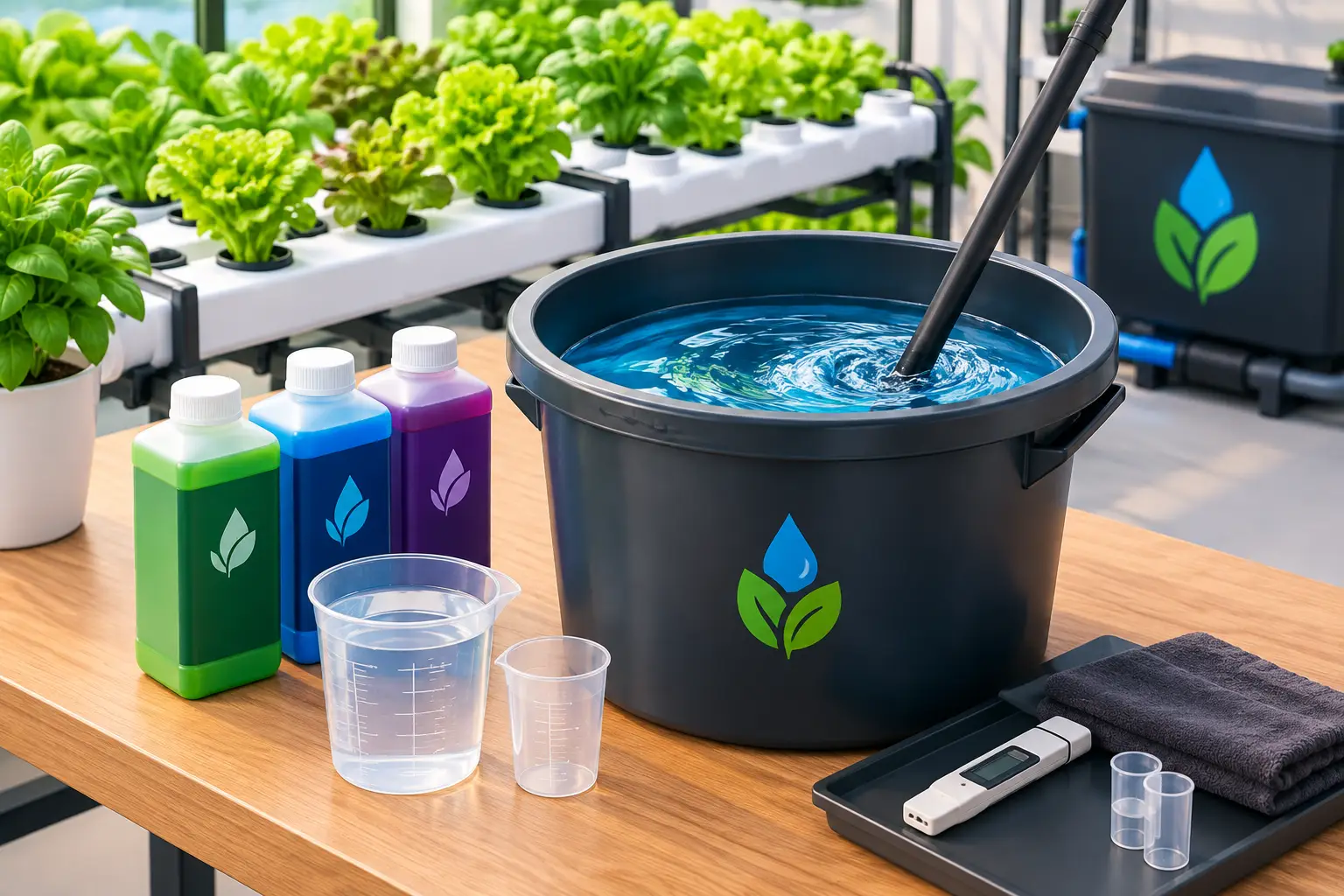
The key is not speed. Give the solution a proper stir after every addition, particularly in a larger tank. A circulation pump is useful for reservoirs, but a clean stirring stick works well for a small batch. Once everything is in, allow the solution to sit for 10 to 15 minutes before taking your final EC and pH readings. Temperature and mixing can cause minor movement in both figures.
Some additives need special care. Silica products, for example, are commonly added to plain water before base nutrients because they can react when added later. Calcium and magnesium supplements may be useful with soft water, reverse-osmosis water or fast-growing plants, but they are not an automatic addition to every tank. If your base nutrient already supplies sufficient calcium and magnesium, adding more can push EC up without improving plant health.
Use EC to set strength, not guesswork
EC measures the concentration of dissolved salts in your nutrient solution. It is one of the most useful tools for making plant feeding consistent, because it tells you how strong the total solution is after all products have been added.
Do not chase a single “perfect” EC number. The right strength depends on plant species, cultivar, growth stage, root health, temperature, light intensity and your growing medium. Young plants and newly rooted cuttings generally need a gentler solution than established plants under strong lighting. Plants in peak vegetative growth or productive flowering may accept a stronger feed, but only if roots, environment and irrigation frequency are all on point.
Use the feed chart as a starting point, then watch what the plant and reservoir tell you. Burnt leaf tips, very dark foliage or a rapidly rising reservoir EC can suggest the feed is too strong or the plant is drinking more water than nutrients. Pale new growth, slow development and a falling reservoir EC may indicate the plant is using nutrients quickly, though poor pH, cold roots or low light can create similar symptoms.
Make changes gradually. If you need to lift EC, add a small amount of already diluted nutrient solution or carefully add the required base nutrients one at a time, then re-test. If EC is too high, dilute with clean water. Large corrections can create more instability than the original reading.
Set pH after your nutrients are mixed
pH controls how easily plant roots can access different elements. You can have a quality nutrient program at the correct EC, but if pH drifts too far from the suitable range, plants may show deficiency symptoms even when the nutrients are physically present in the water.
For most hydroponic crops, a pH around 5.5 to 6.2 is a practical working range. Many growers aim near 5.8, then allow gentle movement within that range rather than forcing the number to remain perfectly fixed. Different plants and systems have their preferences, so use this as a guide rather than a rule that overrides your nutrient brand or crop-specific advice.
Always adjust pH after adding base nutrients and additives. Nutrients change the pH of the water, so adjusting it beforehand wastes time and can lead to over-correction. Use pH Down or pH Up sparingly. Add a very small amount, stir well, wait a few minutes and test again. It is far easier to lower pH a little further than to recover from an overly aggressive correction.
A calibrated meter is worth its place in any grow room. Calibrate your pH and EC meters regularly with the correct calibration solutions, keep probes clean, and store a pH probe according to the manufacturer’s instructions. A dry or neglected probe can give misleading readings that send you chasing problems that are not really there.
Match the mix to your system and growth stage
The same nutrient strength will not behave identically in every setup. In recirculating hydroponics, the reservoir changes as plants drink and feed, so EC and pH should be checked regularly. Top up with water or a light nutrient mix based on what your readings show, rather than automatically replacing what has been used.
In coco or other inert media, frequent runoff checks are useful. Feed strength at the dripper is only half the story. If salts are accumulating in the root zone, the runoff EC can climb above the input EC and eventually stress the plant. Adjusting irrigation volume, frequency or nutrient strength may be more effective than adding another bottle.
For seedlings, fresh transplants and recovering plants, lower strength is usually the safer choice. Strong lighting, warm root-zone temperatures and vigorous established growth can increase nutrient demand, but heat stress or poor airflow can make a normally acceptable feed too much. Bigger yields are built from a stable environment as much as a well-mixed reservoir.
Keep records so each mix gets easier
A simple grow diary turns nutrient mixing from trial and error into a repeatable routine. Record your source-water EC, the products and amounts used, final EC, pH, water temperature and the date. Add notes about plant response over the following days.
This is particularly valuable when changing seasons, moving to a new nutrient line or upgrading lights. If plants respond well, you have a clear recipe to repeat. If something goes sideways, you have useful information to troubleshoot instead of relying on memory.
Avoid mixing more solution than your plants can use while it remains fresh and stable. Keep the reservoir covered to limit light exposure and algae growth, maintain good aeration where required, and replace the solution when it becomes unbalanced, contaminated or outside your normal management range.
The best nutrient routine is the one you can measure, repeat and adjust with confidence. Start conservatively, keep your tools accurate, and let healthy roots and steady new growth guide the next mix. If your water, plant type or nutrient program is unusual, a knowledgeable hydroponic team can help match the feed plan to your setup so your plants get exactly what they need.