
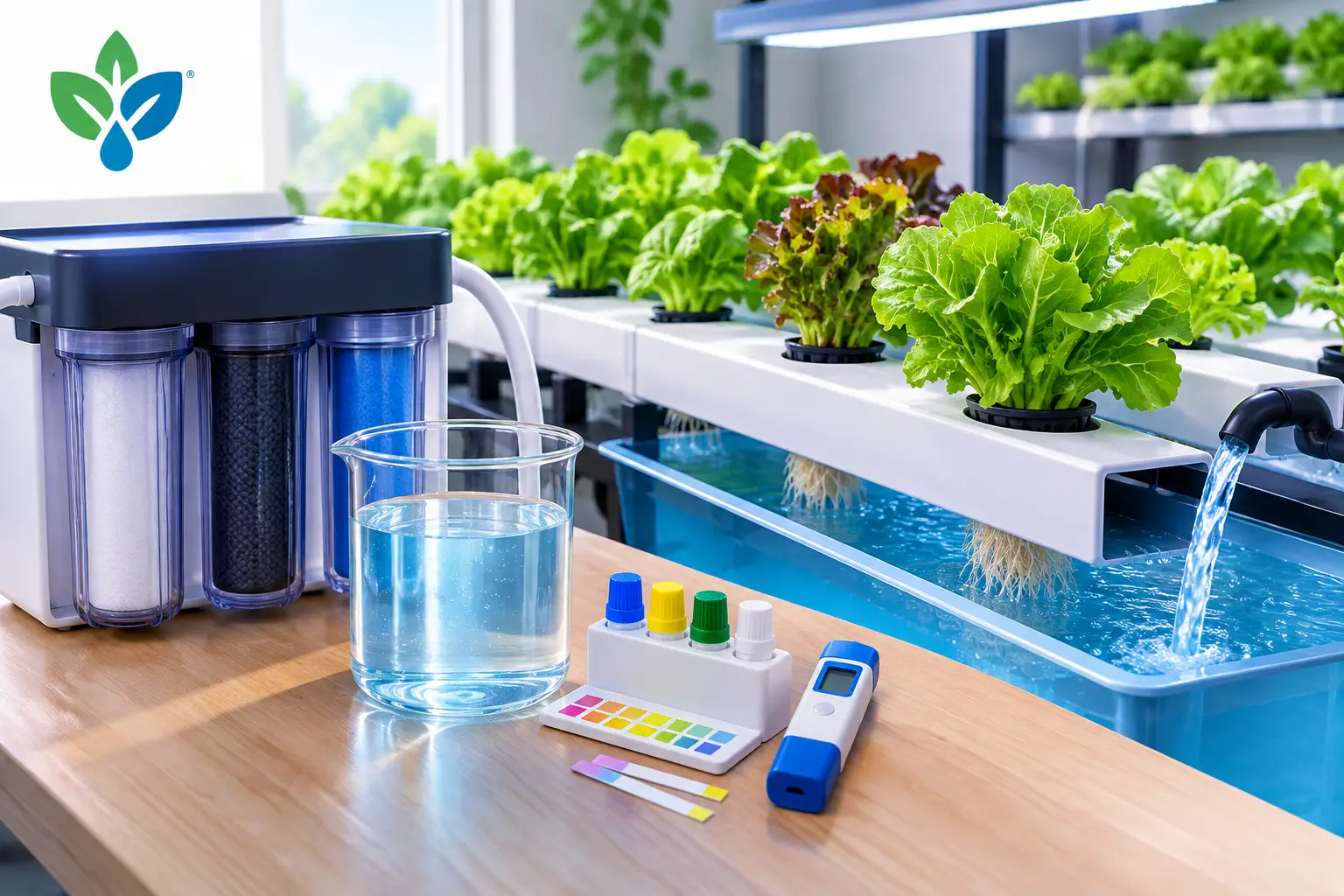
A reservoir can look perfectly clean while quietly holding back an otherwise well-run grow. Pale new growth, burnt leaf tips, slow uptake and recurring root trouble are often blamed on nutrients first. This hydroponic water quality guide starts one step earlier: with the water carrying those nutrients to your plants.
Good water management is not about chasing a single magic number. It is about creating a stable root-zone environment where nutrients stay available, oxygen stays high and plants can transpire and grow without constant correction. Get that right and bigger yields become much simpler to achieve.
Hydroponic water quality guide: start with your source water
Before adding nutrients, test the water coming from your tap, rainwater tank or bore. Two sources that look identical in a bucket can behave very differently once nutrient salts are mixed in.
Start by checking its EC and pH. EC, or electrical conductivity, indicates how many dissolved salts are already present. A low starting EC gives you more room to run a precise nutrient programme. Higher-EC water may contain useful calcium and magnesium, but it can also carry sodium, chloride or excess bicarbonates that make nutrient management harder.
For many town-water supplies, chlorine or chloramine may be present for disinfection. Chlorine can often dissipate with aeration and time, while chloramine is more stable and should not be assumed to disappear by simply leaving water standing. If plants are sensitive, or you run beneficial microbes in the reservoir, a suitable water treatment or filtration approach can be worthwhile.
Hardness and alkalinity matter too. These are related but not identical. Hard water contains higher mineral levels, commonly calcium and magnesium. Alkalinity refers largely to bicarbonates that resist pH movement. Water with high alkalinity can cause pH to climb repeatedly, meaning you use more pH down than expected and see less stable results.
Rainwater often begins with very low EC, which can be useful, but it is not automatically clean. Dust, roofing materials, bird droppings and storage tanks can all affect it. Keep tanks covered, use suitable first-flush collection where possible, and test water from the point you actually fill the reservoir.
When filtration makes sense
Reverse osmosis filtration is useful when source water has consistently high EC, excess sodium, troublesome alkalinity or contaminants that prevent reliable mixing. It gives a very clean baseline, but it also removes minerals, so your nutrient schedule may need calcium and magnesium supplementation depending on the product line and crop.
It is not essential for every garden. If your source water tests low enough and plants are thriving, investing in a quality pH and EC meter, good nutrients and regular reservoir maintenance may produce a better return. The right choice depends on your water report, system size, crop and how much consistency you need.
Balance pH for nutrient availability
pH determines how readily plant roots can absorb individual nutrients. In most hydroponic systems, a pH range of 5.5 to 6.5 works well, with many growers aiming to keep the solution around 5.8 to 6.2.
At a pH that is too high, iron, manganese and phosphorus can become less available. At a pH that is too low, calcium, magnesium and other elements can become more difficult for plants to take up. The result can resemble a deficiency even when the nutrient solution contains enough feed.
Do not expect pH to stay fixed. Plants selectively absorb ions, water evaporates, reservoir levels fall and microbial activity can all shift the reading. A gentle drift within range is normal. Constant large swings are a signal to investigate source-water alkalinity, reservoir cleanliness, root health or mixing practice.
Always measure after nutrients have been fully mixed. Add your base nutrients one at a time, stir thoroughly between additions, then check EC before adjusting pH. Add pH up or pH down in small doses, allow the solution to circulate, and re-test. Adding concentrated products directly together can cause precipitation, leaving nutrients unavailable in the reservoir.
Use EC to feed the crop, not the label alone
EC is one of the best tools for matching nutrient strength to plant demand. It tells you the overall concentration of dissolved nutrient salts, but not whether the formula is balanced. That is why EC works best alongside a proven nutrient range and close observation of your crop.
Seedlings, fresh cuttings and young plants generally require a lighter feed than established vegetative plants. Heavy-fruiting crops may need more nutrition later in the cycle, while stressed plants, high temperatures and low-light periods can reduce uptake. A feeding chart is a sound starting point, not a substitute for watching the plants.
Check the reservoir at roughly the same time each day. If the water level falls and EC rises, plants are likely taking up more water than nutrients. If the water level falls and EC drops, they are taking up nutrients strongly. These trends are more useful than a single reading, especially in recirculating systems.
Avoid correcting every small change. Top up with suitable water when required, make measured adjustments, and give plants time to respond. Sudden jumps in EC can burn roots and leaf edges, while an EC that is consistently too low can limit growth and yield.
Keep the root zone cool, oxygenated and clean
Water temperature has a direct effect on dissolved oxygen. Warm water holds less oxygen and creates friendlier conditions for pathogens, while very cold water can slow root activity. For many hydroponic crops, a reservoir temperature around 18-22°C is a practical target.
In an Australian summer, this can be the difference between healthy white roots and a system that struggles every afternoon. Keep reservoirs out of direct light, insulate where needed, avoid placing pumps where they add unnecessary heat, and use a chiller if room temperatures make stable water impossible. In smaller systems, even shifting the reservoir away from a hot tent wall can help.
Aeration is equally valuable. An air pump and air stone keep solution moving and support oxygen around the roots, particularly in deep water culture. In other recirculating setups, adequate flow and return agitation may contribute oxygen, but dead spots should still be avoided.
Light entering the reservoir encourages algae. Algae competes for nutrients, affects pH and can clog irrigation lines. Use opaque reservoirs and lids, cover unused holes, and keep the outside of the system free from nutrient spills and organic debris.
A simple testing routine that prevents surprises
Consistency beats guesswork. For an active reservoir, check pH, EC and water temperature daily or at least every time you top up. Look at the roots and smell the reservoir while you are there. Healthy roots are generally light-coloured and firm, while a sour smell, slime or browning deserves action before it spreads.
Once a week, inspect pumps, air stones, filters, drippers and return lines. Remove sediment and make sure each plant is receiving an even flow. Calibrate pH and EC meters regularly using the correct calibration solutions. A poor reading can lead to more damage than no reading because it encourages the wrong correction.
A complete reservoir change is often sensible every one to two weeks in smaller recirculating systems, though timing depends on reservoir size, plant size, water temperature and how stable the readings remain. Larger, well-managed systems may run longer. If EC, pH or water appearance becomes difficult to control, refresh the solution rather than stacking more additives into an unstable mix.
Troubleshoot the pattern, not just the symptom
When plants look unhappy, resist the urge to add more products immediately. Check the basics in order: meter calibration, source-water EC, reservoir temperature, pH, EC trend, root condition and irrigation flow. A magnesium deficiency look may stem from poor pH control. Burnt tips may be excess strength, heat stress or poor root oxygen rather than a nutrient formula problem.
Keep a short grow log with dates, readings, top-ups, nutrient changes and observations. It takes only a few minutes and turns recurring issues into visible patterns. That record also makes it far easier to tailor your setup for the next crop.
Water quality is not the flashy part of hydroponics, but it is where reliable growth begins. Build a steady routine, trust your measurements, and make small changes with a clear reason. If your readings never quite match what your plants are telling you, personalised advice on your water source, system and crop can save a lot of trial and error.