
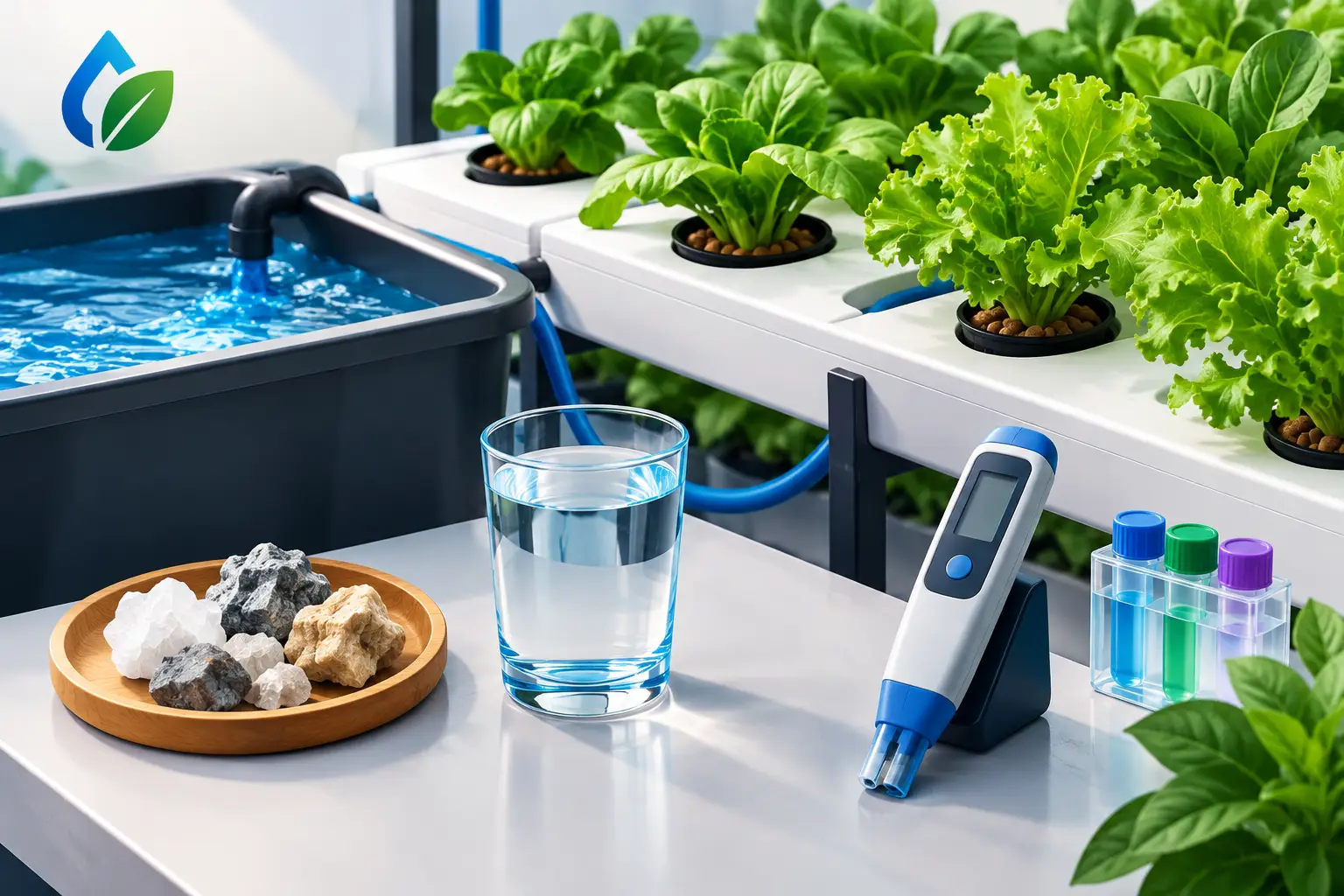
A nutrient recipe can be measured perfectly and still perform poorly if the starting water is working against it. Water hardness in hydroponics affects the calcium, magnesium and bicarbonates already present before you add nutrients. For growers chasing consistent growth, healthy roots and bigger yields, understanding your source water is one of the most useful steps you can take.
Hard water is not automatically bad water. In fact, some hardness can be useful. The key is knowing what is in your water, accounting for it in your nutrient programme, and choosing treatment only when it genuinely improves the result.
What water hardness means in hydroponics
Water hardness refers mainly to dissolved calcium and magnesium. These minerals are picked up as water moves through soil and rock before reaching your tap, bore, tank or dam. Hardness is often reported as parts per million (ppm) of calcium carbonate, or as degrees of hardness.
In hydroponics, though, the number matters less than the minerals behind it. Calcium and magnesium are essential plant nutrients, but excess amounts can throw off the balance of a complete fertiliser. They also contribute to your starting EC, leaving less room for the nutrients you actually need to add.
There is another related factor: alkalinity. Alkalinity describes water’s ability to resist pH change, usually because of bicarbonates and carbonates. People often use hardness and alkalinity as if they mean the same thing, but they do not. Water can be hard with manageable alkalinity, or relatively soft with enough alkalinity to make pH adjustment frustrating.
That distinction explains a common grow-room problem: a reservoir may read an acceptable pH after mixing, then slowly climb again over the next day or two. The bicarbonates in the water are buffering it upwards.
Why hard water can change plant performance
Hard water can alter a nutrient solution in several ways. First, it raises baseline EC. An EC meter sees dissolved salts but cannot tell you whether they are useful calcium, excess sodium, bicarbonates or the balanced mineral profile your plants require. A high starting EC can make it difficult to run an appropriate feed strength, especially with young plants, seedlings or sensitive crops.
Second, excess calcium and magnesium can compete with other nutrients. High calcium may interfere with potassium and magnesium uptake, while too much magnesium can make calcium management harder. The symptoms may look like a deficiency even when the reservoir contains plenty of fertiliser.
Third, high alkalinity can make pH control less stable. Most hydroponic crops perform best when the root zone sits within an appropriate pH range, often around 5.5 to 6.2 for recirculating systems. The ideal target depends on the crop, medium and nutrient line, but frequent pH drift means nutrients can become less available over time.
Hard water may also leave scale inside pumps, drippers, fittings and irrigation lines. In a hand-watered coco grow, this may be a minor nuisance. In a larger recirculating system with fine drippers, scale can gradually reduce flow uniformity and create uneven plant growth.
Test your water before changing your setup
The simplest place to start is with a reliable pH and EC meter. Test fresh source water before adding nutrients, then record the reading. Repeat the test at different times of year if you use town water, as water treatment and supply sources can change. Rainwater, tank water and bore water can vary even more.
EC gives a useful first indication, but it is not a full water report. If your source water has a noticeably elevated EC, persistent pH rise, visible scale, or recurring nutrient issues, a laboratory water analysis is worthwhile. Ask for calcium, magnesium, sodium, bicarbonate or alkalinity, chloride, sulphate, iron and total dissolved solids where possible.
This is especially useful for growers using bore water in regional areas, or tank water collected from roofs. Bore water can carry substantial mineral content, while tank water may be very soft but contain sediment, organic matter or contaminants introduced through collection and storage.
A practical record should include source-water EC and pH, mixed-feed EC and pH, pH movement over 24 hours, and what adjustments were needed. That small amount of information makes diagnosing a problem much easier than relying on a single reservoir reading.
A quick guide to starting EC
There is no universal cutoff, because the mineral profile matters. Still, starting water below roughly 0.2 to 0.3 EC is generally easy to work with for most hydroponic nutrient programmes. Water between 0.3 and 0.6 EC deserves closer attention, particularly when growing seedlings or using a high-strength base nutrient. Above that level, a proper analysis is sensible before assuming the water is suitable as-is.
Do not chase zero EC simply because it sounds cleaner. Very pure water needs a complete, well-managed nutrient programme. If you switch to filtered water without adjusting your feed, plants may miss the calcium and magnesium that your tap water previously supplied.
Choosing the right approach for hard water
Your best option depends on the water report, system type and crop stage. Often, the answer is not a major filtration system. It may simply be selecting a hard-water nutrient formula and mixing it correctly.
Use nutrients designed for harder water
Many nutrient ranges offer hard-water formulations or provide guidance for harder source water. These formulas typically account for the extra calcium and magnesium already present, reducing the chance of oversupply. They are often the most straightforward option when your water is moderately hard but otherwise clean and consistent.
Follow the manufacturer’s mixing order and dosage rather than adding a Cal-Mag product by habit. Cal-Mag can be valuable with reverse-osmosis water, coco coir or clear deficiency symptoms, but adding it to already calcium-rich tap water can worsen the imbalance.
Filter sediment and chlorine when needed
A basic sediment filter is useful where water carries grit or fine particles that could block drippers. Carbon filtration can help reduce chlorine and some unpleasant odours from town water. These filters improve water quality for irrigation equipment and beneficial microbes, but they do not meaningfully remove dissolved hardness minerals.
If chlorine or chloramine is a concern, check what your local water supplier uses. Letting water stand may reduce chlorine, but it is not a reliable fix for chloramine.
Consider reverse osmosis for difficult water
Reverse osmosis, often called RO, removes a large proportion of dissolved minerals. It can be an excellent solution for very hard bore water, water with high sodium, or a source that creates unstable pH and inconsistent results. It gives experienced growers a clean baseline for precise nutrient mixing.
The trade-off is cost, wastewater, slower production and the need to rebuild the mineral profile with a suitable nutrient programme. RO water is not automatically better for every home grower. If your tap water is moderately hard and your plants are healthy, a quality hard-water nutrient may be simpler, cheaper and just as effective.
Blend water to find a practical middle ground
Some growers blend RO water with tap water to lower the starting EC while retaining a small amount of natural calcium and magnesium. This can work well, but measure the final blend every time. A consistent ratio and a calibrated EC meter are essential, otherwise the feed strength changes from batch to batch.
Managing pH and EC after mixing
Always add nutrients to water before making a final pH adjustment. Mix thoroughly, allow the solution to settle briefly, then check EC and pH. Adjusting pH first is wasted effort because nutrients will shift the reading.
In recirculating systems, check pH and EC daily. A slight movement is normal as plants feed and transpire, but a sharp rise in pH or a steady EC increase can point to high alkalinity, excessive feed strength or poor water uptake. A falling EC often means plants are feeding strongly, while a falling water level with rising EC means the solution is becoming too concentrated.
Keep your meters clean, calibrate them regularly with fresh calibration solution, and replace probes when they become slow or unreliable. Good water management is only as accurate as the readings behind it.
Avoid the common hard-water mistakes
The biggest mistake is treating pH symptoms without identifying the cause. Repeatedly adding pH down may bring a reservoir back into range for a few hours, but high alkalinity can keep pushing it upwards. The second is assuming all EC is nutrient strength. Source-water minerals count toward EC, even if they do not match what the plant needs.
It is also easy to overcorrect. A full RO setup, extra Cal-Mag and aggressive pH adjustment can create a more complicated problem than the original hard water. Make one measured change at a time and watch how the crop responds over several days.
For growers unsure where to start, bringing in your source-water readings and nutrient details can save plenty of trial and error. The team at Hunter Hydro can help match a practical testing, filtration and nutrient approach to your system rather than selling treatment you do not need.
Your water is the base of every feed you mix. Test it, understand what it contributes, and let the plants guide the final adjustment. When the water is working with your nutrient programme instead of against it, consistent healthy growth becomes much easier to achieve.