Choosing Hydroponic Water Pumps for Better Yields
A nutrient reservoir can hold the best feed program available, but it cannot help plants if the solution is not delivered evenly. Hydroponic water pumps are the working heart of recirculating systems, moving water and nutrients from the reservoir to roots, drippers or growing channels. Choose one that suits your system and plants receive steadier moisture, oxygen and nutrition – all foundations for healthy growth and bigger yields.
The right pump is not always the largest one on the shelf. A small propagation tray, a multi-pot drip system and a long NFT channel each place very different demands on water movement. Matching pump flow, pressure and plumbing to the job avoids weak irrigation at one end of the garden and wasted energy at the other.
What hydroponic water pumps actually do
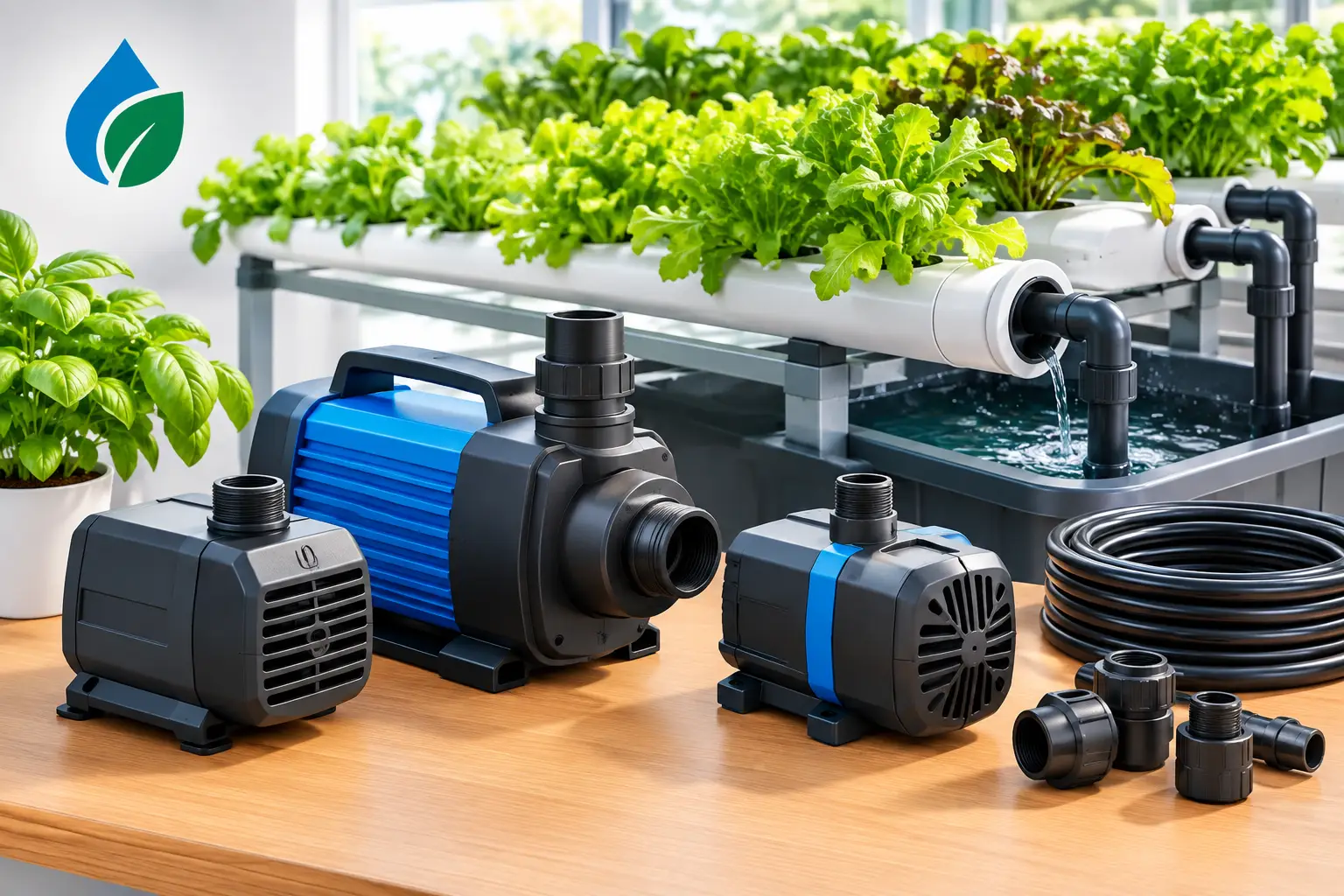
In most hydroponic gardens, a pump sends nutrient solution from a reservoir through pipework to the root zone. Depending on the setup, that may mean flooding and draining a tray, feeding individual drippers, circulating water through NFT channels, or returning solution through a chiller, filter or UV unit.
This circulation does more than wet the media. It keeps dissolved nutrients mixed throughout the reservoir, helps prevent stagnant zones and can support stable root-zone conditions. In deep water culture, an air pump provides oxygenation, while a water pump may be used for circulation or cooling loops. They are different jobs, and one should not be substituted for the other.
For a simple run-to-waste system, the pump may only operate during short timed feeds. In a recirculating system, it may run continuously or for long periods. That duty cycle matters when selecting a reliable unit.
Choosing the right pump for your system
Start with the irrigation method, then work backwards to the pump. It is far easier to select equipment once you know how much solution must reach the plants, how far it must travel and how often the system will run.
Flow rate is only the starting point
Pump flow is commonly shown in litres per hour. It tells you how much water a pump can move under ideal conditions, usually with no lift and minimal restriction. A pump rated at 2,000 L/h does not necessarily deliver 2,000 L/h once you add vertical height, elbows, narrow tubing, manifolds and drippers.
For NFT, the aim is a consistent shallow flow through every channel rather than a fast rush of water. For drip irrigation, calculate the combined output of your drippers and allow extra capacity for pressure losses. If you have 20 drippers rated at 4 L/h, they require 80 L/h at their intended operating pressure. The pump needs enough real-world output to supply that demand evenly across the line.
Flood and drain systems need enough flow to fill the tray within the desired cycle time, without exceeding the capacity of the overflow fitting. A larger reservoir or tray does not automatically demand a high-flow pump. The plumbing layout and fill time are what count.
Head height changes everything
Head height is the vertical distance a pump pushes water from its water level to the highest point of the irrigation line. Every pump has a maximum head rating. As it lifts water closer to that limit, its actual flow falls sharply.
Measure from the reservoir waterline, not the floor, to the highest outlet. Then factor in resistance from fittings and hose length. If the reservoir sits below a tent or greenhouse bench, this calculation is particularly important. Choosing a pump with comfortable head-height capacity gives you room for filters, valves and small layout changes later on.
Submersible or external?
Submersible pumps sit inside the reservoir. They are compact, generally quiet and straightforward for most home hydroponic systems. They are a practical choice for nutrient circulation, NFT, small flood and drain setups, and drip systems where the reservoir is nearby.
External pumps sit outside the reservoir and are commonly used where higher flow, stronger pressure or larger plumbing is needed. They can be easier to access for servicing, but they need correct priming, secure fittings and careful leak management. For most hobby gardens, a quality submersible pump is the simpler option. Larger greenhouse systems may benefit from the performance and serviceability of an external model.
Match the pump to the root zone
Plants growing in coco, clay balls, rockwool or other media rely on irrigation frequency as much as total water volume. A pump and timer work together to deliver short, repeatable feeds that suit the media, plant size, temperature and growth stage. Young plants with small root systems should not be treated like established, heavily flowering plants in large pots.
Drip stakes, rings and manifolds also influence pump choice. A system with uneven drippers can leave some pots too wet and others too dry, even when the pump seems powerful enough. Use matching emitters, sensible line lengths and a layout that keeps runs as balanced as possible. Check output from the first and last dripper before trusting the system unattended.
NFT systems have their own balance. Too little flow can create dry patches in the channel, while excessive flow can reduce the air space around the roots and make return lines noisy. The right setting is a stable film of nutrient solution, with healthy white roots and no pooling at the channel base.
Protect water quality and pump life
A pump cannot compensate for a poorly maintained reservoir. Fine roots, sediment, organic additives and debris can clog impellers and restrict drippers. Keep the reservoir covered to reduce light exposure, algae growth and contamination. A pre-filter or pump guard is useful where plant material could enter the intake, but clean it regularly so it does not become the restriction.
Heat is another consideration in Australian grow spaces. Submersible pumps add a small amount of heat to nutrient solution, particularly when they run continuously. In a warm tent, garage or greenhouse, monitor reservoir temperature rather than assuming it will stay within range. If solution runs too warm, dissolved oxygen decreases and root problems become more likely. Better airflow around the reservoir, shorter pump run times where appropriate, insulation or a dedicated cooling approach may be needed.
Maintain pH and EC after topping up or mixing nutrients, then allow the pump to circulate the solution before taking final readings. This gives you a more representative result and helps ensure the entire reservoir is properly mixed.
Set up for reliable irrigation
Position a submersible pump so its intake stays clear of sediment at the very bottom of the reservoir. Secure tubing so it cannot lift out and spray the grow area, and avoid sharp bends that pinch the line. Use the correct hose size for the pump outlet. Undersized tubing can reduce flow and place unnecessary strain on the pump.
Run electrical leads with a drip loop below the power point and use suitable protected electrical equipment around water. Keep connections dry and never handle electrical gear with wet hands. Before adding plants, run the system with plain water and inspect every join, dripper and return line. It is much easier to correct a leak or uneven feed before roots fill the system.
Timers should match the growing method. Continuous flow can suit NFT, while drip-fed media systems often need scheduled irrigation. Start conservatively, observe moisture levels and root health, then adjust based on plant response. The best schedule is not a fixed number copied from another garden – it reflects your media, climate, pot size, plant maturity and nutrient strength.
Simple maintenance prevents costly failures
Check pump operation daily when possible, especially in warm weather or during high-demand flowering periods. Listen for a change in sound, inspect flow at the furthest outlet and confirm the reservoir has enough solution to keep the pump submerged. Running dry can quickly damage many submersible pumps.
Between crops, disconnect the pump, remove the cover and clean the impeller chamber according to the manufacturer’s instructions. Rinse away nutrient residue and check for root fragments or grit. Flush irrigation lines if you have used products that can leave deposits, and replace blocked drippers rather than hoping they will clear during the next feed.
A spare pump is sensible insurance for larger gardens or systems that depend on frequent irrigation. It does not need to be identical if it can safely keep the system running while the main unit is cleaned or replaced.
The best pump is the one that delivers even irrigation without adding unnecessary heat, noise or complexity to your garden. If you are planning a new system or solving inconsistent feeds, bring your reservoir size, lift height, number of outlets and growing method into the conversation. A properly matched pump keeps the background work quiet, leaving your plants free to show the results.