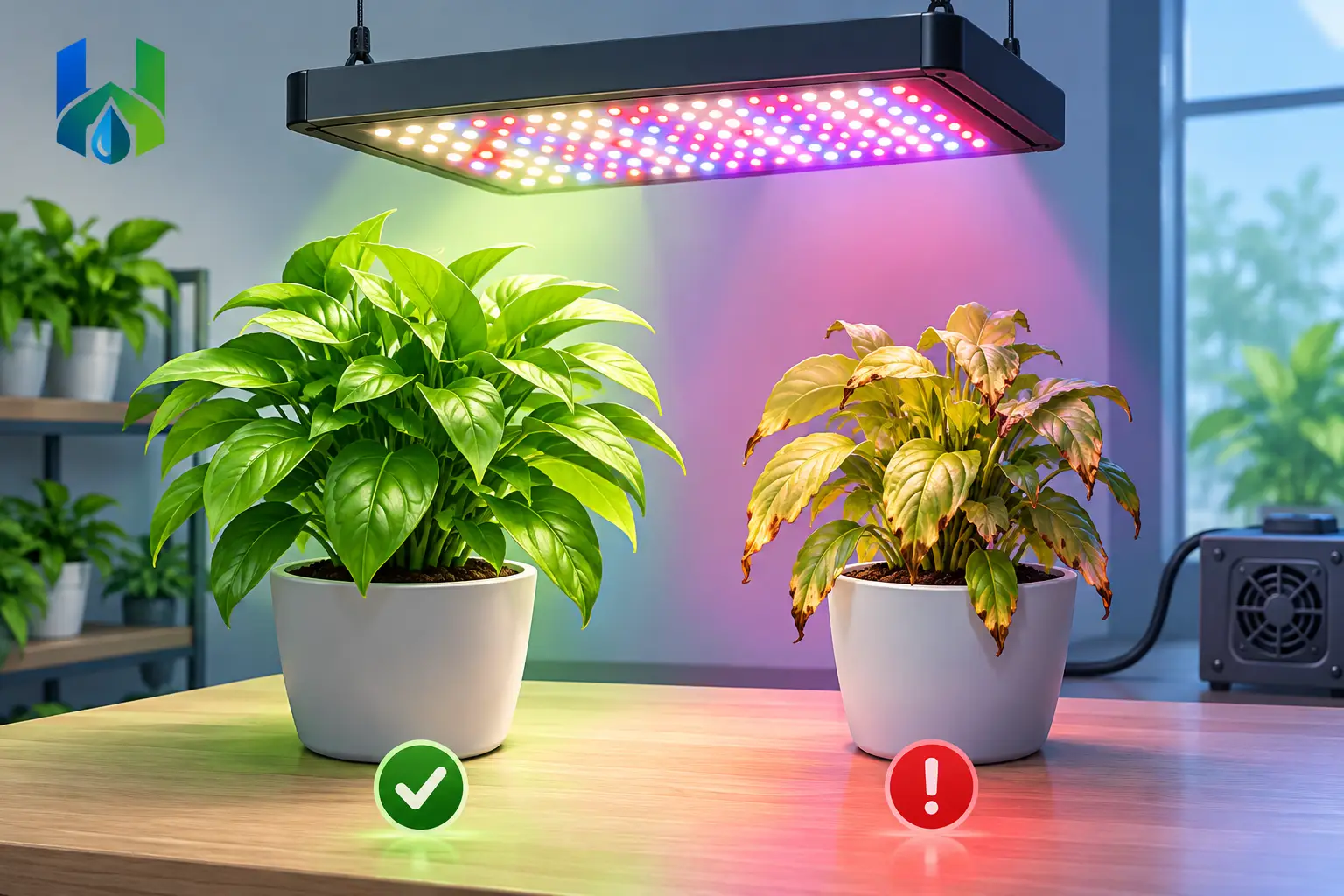
A new LED can make a grow space look brilliantly productive, then leave the upper leaves pale, curled or dry within days. So, can LED lights burn plants? Yes, but it is usually not a traditional heat burn. More often, plants are receiving more usable light than they can process, creating light stress or photobleaching. The fix is not simply buying a weaker light. It is matching output, height and operating time to the plant, its growth stage and the conditions around it.
What LED light burn actually looks like
LED grow lights produce far less radiant heat than older HID lamps, but they can still deliver a very high amount of photosynthetically active light directly to the canopy. When that light level exceeds what leaves can use for photosynthesis, chlorophyll can be damaged faster than the plant can recover. The result is often called light burn, light bleaching or photoinhibition.
The earliest signs normally show on the highest, most exposed leaves. Look for yellowing or whitening between veins, faded patches that do not begin at the leaf tip, leaves that turn upwards at the edges, and fresh growth that appears unusually small or rigid. In severe cases, the leaf surface can become crisp and papery.
This differs from nutrient burn, which more commonly starts as browned tips and margins, particularly on older leaves. It can also differ from heat stress, although the two often occur together. A powerful LED may not radiate much heat downwards, but its driver, poor extraction or stagnant air can still push leaf temperatures beyond a comfortable range.
Why LEDs can burn plants despite running cool
The old rule of placing your hand under a lamp to judge whether it is safe is not reliable with LEDs. Your hand may feel comfortable while the plant receives an excessive photon load. Plants respond to light quantity and spectrum, not just the warmth you can feel.
Light intensity is usually measured as PPFD, or photosynthetic photon flux density, in micromoles per square metre per second. This tells you how much plant-usable light reaches a specific point in the canopy. The total light delivered over a full day is called DLI, or daily light integral. A sensible PPFD can still become excessive if the light is on too long each day.
For example, a low-light foliage plant may be happiest under a modest intensity and a shorter photoperiod. Fruiting plants in full flower can use substantially more light, provided root-zone health, nutrition, carbon dioxide, temperature and airflow are all well managed. A plant cannot turn extra photons into growth if another essential input is limiting.
Fixture design also matters. Modern full-spectrum LED boards and bar lights can spread light evenly across a tent, while compact fixtures may create a strong hotspot directly beneath the centre. Two lights with the same wattage can produce very different canopy readings. That is why a recommended hanging height on the box is a starting point, not a permanent setting.
Distance is a major control point
Moving a light closer does more than make the canopy brighter. It can sharply increase intensity at the top leaves while leaving the edges comparatively dim. Plants with an uneven canopy are especially vulnerable, as one tall branch may sit in the danger zone even when the rest of the crop looks fine.
If bleaching appears, raise the fixture first, then observe new growth for several days. If your unit is dimmable, reducing output is often a better option than hanging the light excessively high, as it maintains a more even footprint. The right approach depends on your available headroom, canopy size and the fixture’s spread.
Heat and humidity can turn stress into damage
Leaf temperature matters more than the room temperature displayed on a controller. If warm air is trapped at canopy level, leaves transpire faster and can struggle to keep themselves cool. Very dry air makes this worse, particularly in a tent with a powerful light and insufficient circulation.
Use oscillating fans to keep air moving gently across and beneath the canopy, without blasting leaves constantly from one direction. Make sure extraction is adequate for the heat produced by the light, driver and other equipment. In Australian summers, a grow room that is comfortable early in the day can become stressful once ambient temperatures climb.
How to tell light stress from other plant problems
Accurate diagnosis prevents unnecessary changes to your nutrient program. If only the uppermost leaves directly under the LED are paling while lower leaves remain healthy, excess light is a likely cause. If symptoms are spread evenly throughout the plant, check pH, EC, root health and irrigation practices before blaming the fixture.
Magnesium deficiency can resemble light stress because it may cause yellowing between leaf veins. The difference is position and pattern. Magnesium issues often develop on older leaves and can spread through the plant, while LED bleaching usually targets the newest growth nearest the light.
Pest damage can also cause speckling and dull foliage. Check the undersides of leaves for mites, thrips or webbing before adjusting your light. If you are growing hydroponically, confirm that pH and EC are within the appropriate range for your crop. A stressed root zone reduces a plant’s ability to cope with strong light, even when the PPFD itself would otherwise be suitable.
Set LED intensity for the growth stage
Seedlings and fresh cuttings need enough light to establish roots without being pushed hard. Begin with the LED raised and dimmed where possible. A gentle, even light level encourages compact growth while avoiding dehydration in young plants with limited root systems.
Vegetative plants can generally handle more intensity as their root mass, leaf area and nutrient demand increase. Increase output gradually rather than making a large change overnight. Watch the newest leaves, internode spacing and overall posture. Healthy leaves tend to sit open and receptive; leaves that taco, curl or bleach are asking for an adjustment.
Flowering and fruiting plants often benefit from stronger light, but this is where growers can overreach. High-output lighting raises demand for water, nutrients and environmental control. If irrigation is inconsistent, EC is too high, roots are oxygen-starved or temperatures are unstable, simply increasing light can reduce quality rather than improve yield.
A PAR metre is the most direct way to assess PPFD across your canopy. Take readings at several points, including the centre, corners and tallest plants. If you do not have a metre, use your fixture manufacturer’s PPFD map as a guide and make smaller changes based on plant response. Mobile apps can offer a rough indication but should not be treated as precision instruments.
A practical way to fix LED burn
When you suspect LED light stress, avoid changing every variable at once. Raise or dim the light, improve airflow and check that your timer is running the intended schedule. Then allow the plant time to respond. Existing bleached tissue will not turn green again, so judge improvement by the colour and shape of new growth.
Use this order to troubleshoot the issue:
- Check the actual distance from the fixture to the tallest leaves, not the average canopy height.
- Reduce intensity or raise the light in a measured increment.
- Confirm the photoperiod suits the crop and its stage of growth.
- Check canopy temperature, humidity and air movement with lights on.
- Verify root-zone pH, EC and irrigation frequency before increasing light again.
Do not compensate for light stress by adding extra nutrients. A higher EC can make leaf-edge burn worse and place more pressure on roots. Keep the nutrient solution appropriate for the plant’s stage, maintain clean water and make one adjustment at a time.
Prevent light burn before it starts
The safest approach is to acclimatise plants whenever you install a new LED, move plants from outdoors, or shift a crop into a different growth stage. Start conservatively, then increase light over several days or a week. This gives the plant time to build protective pigments and adjust its photosynthetic capacity.
Keep the canopy even through training, pruning or plant stands where appropriate. An even canopy makes it far easier to set a safe, productive light height. It also improves airflow and ensures more of your growing area receives useful light instead of allowing a few tall tops to take the full output.
Quality LED lighting can deliver dense growth, stronger flowering and efficient energy use, but more power is not automatically more yield. The best result comes from balancing light with healthy roots, accurate pH and EC, correct nutrition, suitable temperature and reliable airflow. If you are unsure where your light should sit or whether your plant can handle more intensity, Hunter Hydro can help match the setup to your space and growing goals. Your plants will always give feedback – the key is making measured adjustments before a little stress becomes lasting damage.