A healthy grow room should not feel still. Warm, humid air trapped around leaves creates ideal conditions for fungal disease, weak stems and uneven growth. When comparing an inline fan vs oscillating fan, the key is knowing that they do different jobs. One manages the whole room’s air exchange, while the other keeps air moving around the canopy. For most indoor gardens, it is not a matter of choosing one over the other. It is about using each fan where it makes the biggest difference to plant health and yield.
Inline Fan vs Oscillating Fan: The Core Difference
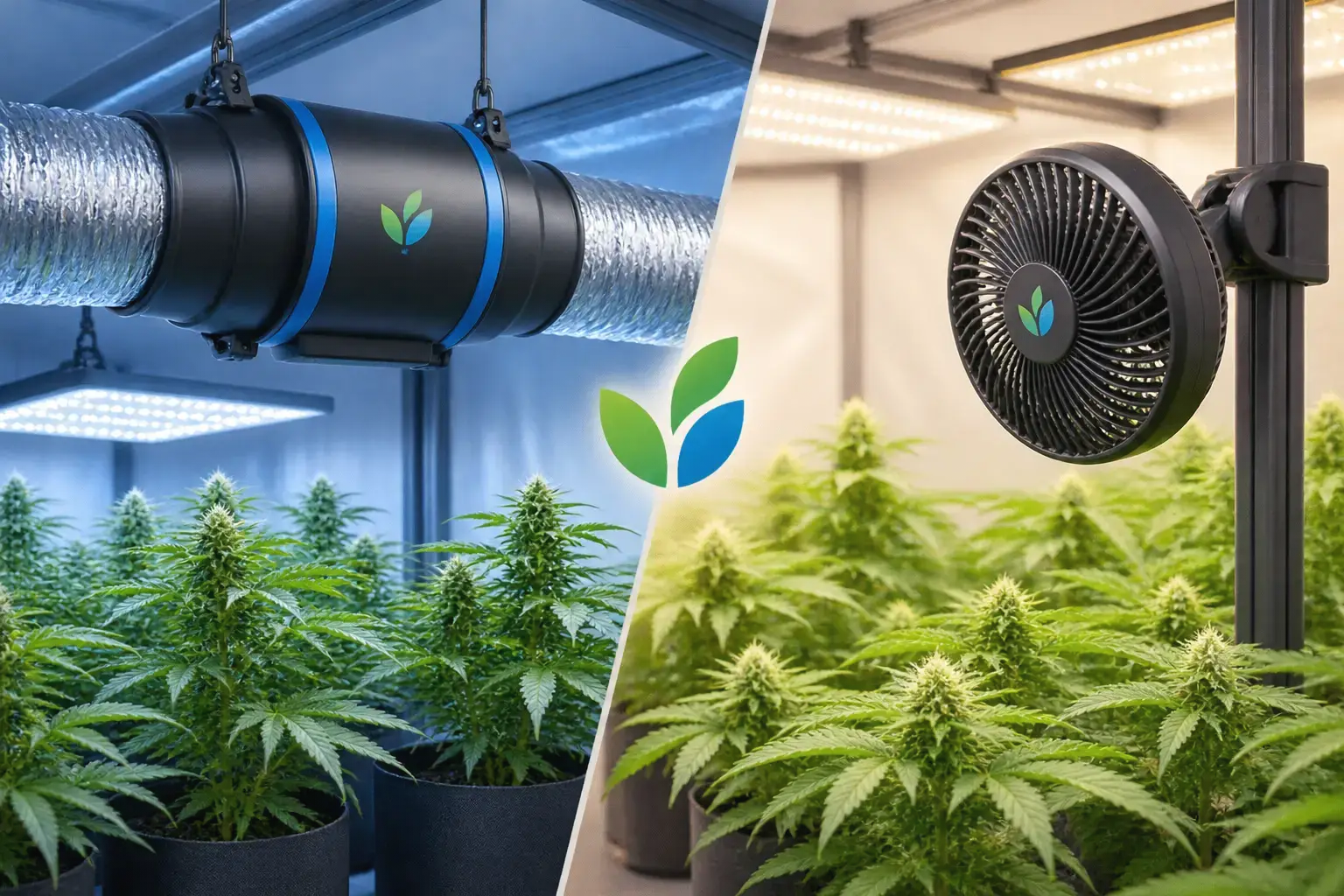
An inline fan moves air into or out of an enclosed space through ducting. In a grow tent, it is usually installed as an exhaust fan, pulling hot and humid air through a carbon filter and venting it outside the tent. This creates negative pressure, helps control odour and brings fresh air into the growing area through passive intake vents or an active intake fan.
An oscillating fan sits inside the tent or grow room and moves air across the plants. Its purpose is circulation, not extraction. By sweeping airflow across the canopy, it reduces stagnant pockets of humid air and encourages plants to develop stronger stems.
Put simply, an inline fan changes the air in the room. An oscillating fan distributes the air already in the room. If you run an oscillating fan without extraction in a sealed tent, you are simply moving the same heat and humidity around. If you run only an inline fan, fresh air may enter the tent but the canopy can still develop damp, stagnant zones.
What an Inline Fan Does for Your Grow
Your grow lights, pumps, dehumidifier and plants all add heat or moisture to the environment. An inline exhaust fan is your main tool for removing that load. It draws out warm, humid air and replaces it with cooler, fresher air from outside the tent or grow space.
This matters because temperature and relative humidity directly influence transpiration. When humidity climbs too high, plants struggle to release moisture efficiently. In dense flowering crops, humid still air can also increase the risk of mould developing deep inside the canopy, where it may not be obvious until damage is well underway.
An inline fan also supports carbon filtration. Air is pulled through the filter before leaving the tent, helping to manage odour while keeping the tent walls gently drawn inward. This slight inward pull is a good sign that negative pressure is working. It means unfiltered air is less likely to escape through gaps around zips, duct ports and cable openings.
Choosing the right inline fan size
Inline fan performance is generally rated in cubic metres per hour, or m³/h. Start by calculating the volume of your tent: length x width x height. A 1.2 m x 1.2 m x 2 m tent, for example, holds 2.88 cubic metres of air.
As a practical starting point, aim to exchange the tent’s air every one to three minutes. But do not select an inline fan based only on this simple calculation. Carbon filters, long duct runs, bends, reducers and silencers all restrict airflow. A fan that looks oversized on paper often performs just right once it is connected to a filter and ducting.
Hot Australian summers can also change the equation. If the intake air is already warm, extraction alone may not bring temperatures down enough. A larger speed-controlled fan gives you more room to respond, but it cannot make hot intake air cold. In that situation, reducing light output, adjusting the light schedule or cooling the room outside the tent may be needed.
A speed controller is especially useful. It lets you run a larger fan quietly at lower speed for much of the cycle, then increase extraction when lights are on, humidity rises or flowering plants become denser.
What an Oscillating Fan Does for Your Grow
An oscillating fan produces gentle, moving airflow through and around the canopy. This helps prevent moisture from sitting on leaf surfaces, evens out temperature and humidity within the tent, and encourages sturdier branch development. Plants exposed to a light, variable breeze generally build stronger stems than plants growing in completely still air.
The movement should look natural. Leaves should flutter or gently sway, not fold over, twist or constantly whip in one direction. Strong direct airflow can cause windburn, which often shows as dry, curled or damaged leaf edges. It can be mistaken for nutrient issues, particularly when the affected leaves are closest to the fan.
Oscillation is valuable because the fan is not fixed on one section of the canopy. A stationary fan can leave some plants under constant pressure while other areas receive very little movement. An oscillating model spreads circulation more evenly and is usually a better fit for tents with several plants or a broad, full canopy.
Fan placement matters more than maximum speed
Mount an oscillating fan above or level with the canopy where possible, aimed so the air passes across the plants rather than directly into one plant. As plants grow taller, raise the fan or adjust its angle to maintain gentle movement over the top of the canopy.
In a crowded tent, a single fan above the canopy may not be enough. Dense foliage restricts airflow underneath, which is where moisture can linger after watering or during the dark period. Adding a second small fan lower down can help move air beneath the canopy. Keep it indirect and avoid blowing constantly at pots or growing media, as this can dry the root zone faster than intended.
Clip fans are convenient in compact tents, but check their condition regularly. Fans operate for long hours in warm, humid environments, and a loose mount, worn motor or failing oscillation mechanism can become a reliability issue. Secure cables neatly and keep all electrical connections away from reservoirs, runoff and spray.
Why Most Growers Need Both Fans
A productive indoor garden needs both air exchange and air circulation. Think of the inline fan as the system that resets the environment, while the oscillating fan prevents microclimates within it.
This combination becomes more important as plants mature. Small seedlings in a spacious tent may need only light airflow and modest extraction. Once the canopy fills out, leaves overlap, transpiration increases and humidity becomes harder to manage. During late flowering, good extraction and canopy movement can be the difference between maintaining a stable environment and fighting persistent moisture problems.
There are a few exceptions. An open greenhouse or outdoor shade structure may already have enough natural air exchange, although circulation fans can still be useful during humid, windless weather. A fully sealed, CO₂-enriched room uses a different approach again, often relying on air conditioning, dehumidification and sealed-room equipment rather than continuous exhaust. For the typical tent grower, though, an inline exhaust fan plus one or more oscillating fans is the dependable starting point.
Match Your Fans to Your Growing Stage
Young plants need airflow, but not a gale. Keep the oscillating fan on a low setting and avoid directing it at freshly rooted cuttings or small seedlings. Their stems benefit from movement, but their root systems are still developing and they can dry out quickly.
In vegetative growth, increase circulation as the canopy expands. This is a good time to tidy overcrowded growth, improve spacing and make sure air can travel through the middle of the plants. Stronger circulation supports even growth and makes environmental readings from your thermometer and hygrometer more representative of the whole tent.
Flowering plants usually require the closest attention. Larger leaves and dense flowers hold moisture, especially when lights switch off and temperatures fall. Keep extraction running consistently, maintain gentle canopy movement and check humidity at plant level rather than only at the top of the tent. If humidity rises sharply during lights-off, improve extraction, reduce unnecessary moisture sources or consider a dehumidifier for the room housing the tent.
A Practical Setup Check
Before buying more equipment, assess what your current fans are actually doing. With the tent closed, the walls should pull in slightly when the inline fan is running. Check whether leaves throughout the canopy are moving gently, including lower branches. Then compare temperature and humidity with lights on and lights off.
If heat and humidity remain high despite good extraction, look at intake air temperature, duct length, carbon filter restriction and whether the fan is operating at full capacity. If only certain leaves show problems, fan placement may be the issue rather than fan size. Small adjustments can have a noticeable effect on plant comfort and growth consistency.
The best fan setup is the one matched to your tent size, light load, plant density and local conditions. Measure the space, watch how your plants respond and make changes before humidity or heat becomes a bigger problem. If you are unsure which capacity or style suits your setup, the Hunter Hydro team can help turn those measurements into a practical ventilation plan that supports healthier plants and bigger yields.