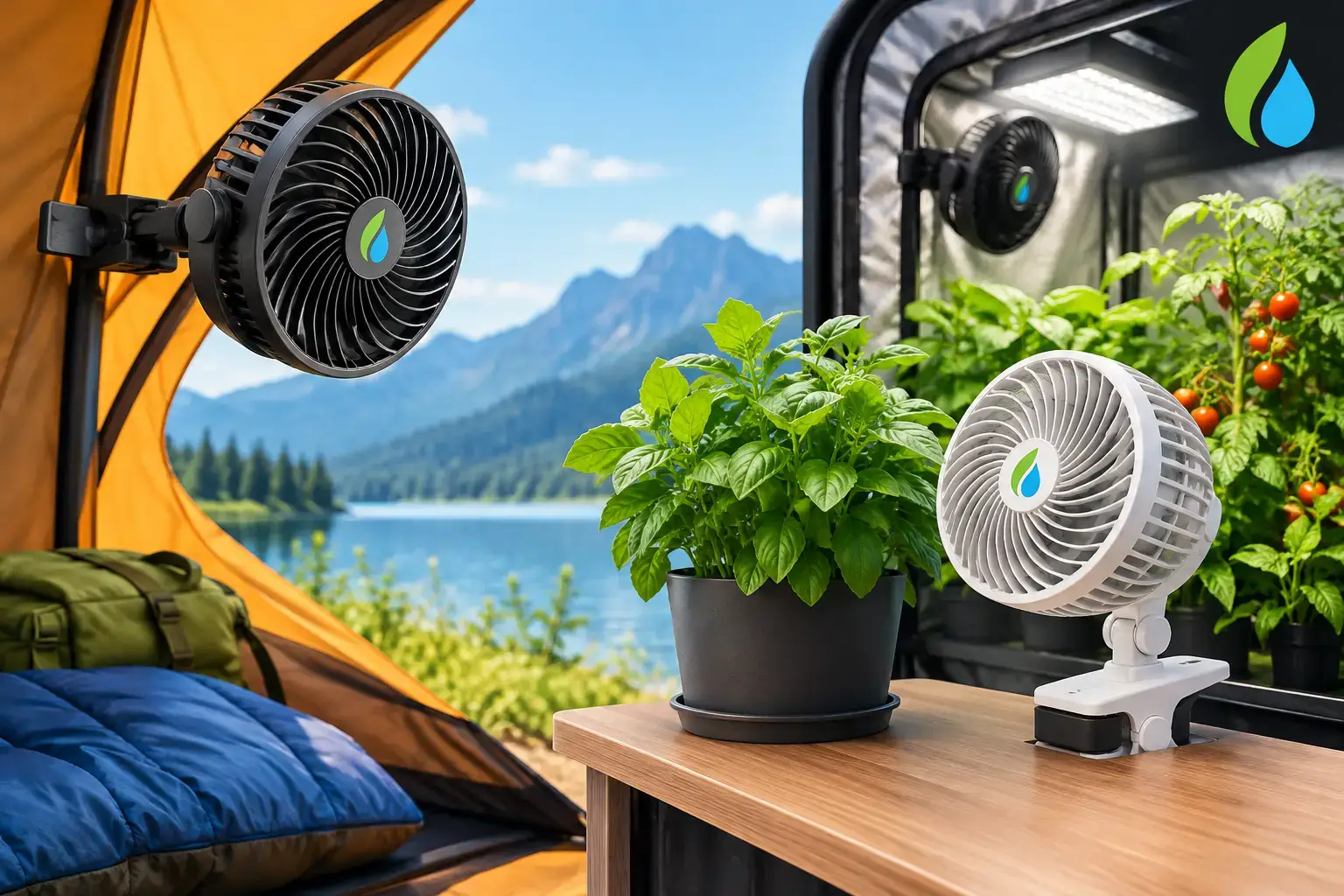
A clip fan may be one of the smallest pieces of equipment in your grow tent, but it has a major effect on plant health. The best clip fans for tents keep air moving through the canopy, reduce humid pockets around leaves and help plants develop stronger stems without taking up valuable floor space. Get airflow right early and your lighting, nutrients and environmental control can work much more effectively.
For most indoor growers, the goal is not to blast plants with wind. It is to create a gentle, consistent movement that replaces stale air around foliage and keeps temperature and humidity more even from the top of the tent to the pots below.
Why clip fans matter in a grow tent
Plants use carbon dioxide from the air during photosynthesis. When the air around leaves becomes still, the plant can quickly use the available CO2 in that tiny space. Gentle circulation refreshes that boundary layer, helping plants access what they need while also releasing moisture from the leaf surface.
This matters most in a crowded tent. As plants fill out, large leaves overlap and create humid, shaded zones in the middle and lower canopy. Those areas dry slowly after watering or foliar spraying, which can increase the risk of fungal disease and pest issues. A well-positioned clip fan helps prevent this by moving air where extraction alone may not reach.
Air movement also encourages sturdier growth. A plant that experiences a light, natural sway generally builds stronger stems than one growing in perfectly still air. That can be particularly useful as plants carry heavier flowers or fruit later in the cycle.
What makes the best clip fans for tents?
The right fan depends on tent size, plant density, lighting heat and your extraction setup. A small propagation tent does not need the same airflow as a packed 1.2 metre flowering tent. Rather than choosing the strongest fan available, look for control, secure mounting and dependable operation.
Adjustable speed is worth having
A fan with multiple speed settings gives you room to adjust as the grow changes. Young seedlings and freshly rooted cuttings need only the lightest movement. Mature plants with a dense canopy often need more circulation, particularly when humidity rises during lights-off periods.
Variable speed also helps you avoid wind stress. Leaves that are constantly curled, ripped or pushed hard in one direction are receiving too much direct airflow. The ideal setting makes leaves gently flicker or sway, not flap aggressively.
Oscillation improves coverage, but it is not essential
An oscillating clip fan sweeps airflow across a wider area, reducing the chance of one section of canopy receiving all the breeze. This can be very useful in medium and large tents, especially where plants are arranged wall to wall.
Fixed fans can still do an excellent job when positioned thoughtfully. They are often simpler, and several fixed fans aimed across or above the canopy can create a reliable circulating pattern. In a compact tent, a fixed fan set at low speed may be all you need.
A secure clip protects plants and equipment
Tent poles are ideal mounting points, provided the fan clip grips firmly. Look for a strong clamp that suits the diameter of standard tent framework and stays secure when the fan vibrates. A loose fan can fall onto plants, lights, irrigation lines or reservoirs.
Check the mounting point whenever you inspect the tent. Fabric, cable ties or ducting should not interfere with the clip, and the fan lead should be routed neatly away from water and walkways. Electrical safety is part of good grow-room practice, not an afterthought.
Quiet operation makes a real difference
Fans run for long hours, so noise can become frustrating in a bedroom, spare room or attached garage. A quieter motor is easier to live with, but it also makes changes in sound easier to notice. Rattling, scraping or an inconsistent hum may indicate a dirty blade, a loose mount or a fan that needs replacing.
Guard design and easy cleaning matter
Clip fans collect dust, fine substrate particles and plant debris. A removable guard or an accessible grille makes regular cleaning much easier. Dirty blades move less air and can spread dust through the tent. Switch the fan off and unplug it before cleaning, then use a soft brush or damp cloth as appropriate for the unit.
Choosing fan size for your tent
In a small tent, one compact clip fan is often enough to keep seedlings, herbs or a few small plants moving gently. Aim it across the space rather than directly at the plants. If the tent is full of mature plants, adding a second fan at a different height can eliminate stagnant pockets.
Medium tents usually benefit from two circulation points. One fan can move air across the upper canopy, while another works through the middle or beneath the canopy. This is particularly helpful under powerful LED grow lights, where the canopy can become warm while lower areas remain humid.
Larger tents and high-density gardens may need several fans. It is generally better to use multiple lower-speed fans than one powerful fan pointed at the centre of the crop. This creates more even circulation and reduces windburn on the plants closest to the fan.
Your extraction fan and carbon filter handle air exchange by removing warm, humid air and bringing fresh air into the tent. Clip fans have a different job: they circulate the air already inside. One cannot fully replace the other. A healthy tent environment usually needs both working together.
Where to place clip fans in a grow tent
Start by mounting a fan near the upper third of the tent, angled just above or across the canopy. This helps break up heat that gathers below the grow light and keeps the leaf surface dry. Avoid aiming it straight down at one plant or directly at the substrate, as this can dry pots unevenly.
As plants become denser, place another fan at mid-canopy level so it pushes air through gaps between branches. In a humid flowering space, a low-positioned fan directed beneath the canopy can be valuable too. It helps air reach the area where fallen leaves, runoff and crowded pots can create damp conditions.
Try to establish a circular airflow pattern. For example, one fan moves air from one side of the tent while another supports movement back across the opposite side. Check the result by watching leaves at several points in the canopy. If plants on one side never move, that zone needs attention.
Do not point a fan directly at a humidifier outlet, nutrient reservoir or freshly watered medium. You want moisture managed evenly, not blown onto leaves or concentrated around electrical equipment.
Adjust airflow as plants move through each stage
Seedlings and cuttings are easily stressed, so keep fans at a distance and use the lowest setting. You should see only the faintest movement. Strong airflow can dry delicate foliage too quickly before roots are ready to keep up.
During vegetative growth, increase circulation gradually as plants develop more leaves and branches. This is the stage where gentle movement supports strong structure and keeps a fast-growing canopy fresh.
In flowering or fruiting stages, inspect airflow more often. Plant density rises, transpiration increases and humidity can become harder to control. Redirect fans as the canopy grows rather than leaving them fixed in the position that worked weeks earlier.
Common clip fan mistakes to avoid
The most common error is treating a clip fan as a set-and-forget item. Plants grow, leaves block airflow and conditions change between seasons. Australian summer heat, wet weather and a busy tent can all require a different fan setting or position.
Avoid these four issues:
- Running one fan at maximum speed directly at the nearest plant.
- Mounting a fan where it can fall, get wet or pull on its own power cord.
- Allowing leaves, ducting or tent walls to obstruct the fan blades or grille.
- Forgetting to clean the fan and check it for vibration, heat or unusual noise.
A fan should support your temperature and humidity targets, not mask a ventilation problem. If humidity remains high despite several clip fans, assess extraction capacity, intake, plant density, watering practices and the conditions in the room outside the tent. A hygrometer at canopy height gives you much clearer information than guesswork.
The best setup is the one that matches your tent, crop and growing conditions. Start with gentle airflow, observe how plants respond and make small adjustments as the canopy develops. If you are unsure whether your space needs one fan or several, the team at Hunter Hydro can help match your equipment to the size of your grow and the results you are aiming for.