A seedling that shoots up quickly can look healthy at first. Then it leans towards the window, develops a thin stem and struggles to hold its first true leaves upright. Understanding why seedlings grow leggy indoors helps you correct the cause early, before those small plants become weak, stretched adults.
Legginess is not usually one mistake. It is a plant’s response to conditions that tell it to reach for better light or grow faster than its roots and stem can support. The good news is that compact, sturdy seedlings are achievable in a tent, greenhouse or bright indoor propagation area when light, temperature, airflow and feeding work together.
Why seedlings grow leggy indoors
Insufficient light intensity is the usual culprit
Seedlings need enough usable light to photosynthesise properly. A bright room to us can still be dim to a young plant, particularly a metre or two back from a window. On cloudy Hunter-region days, short winter days, or in rooms with tinted glass and eaves, natural light can be even less reliable.
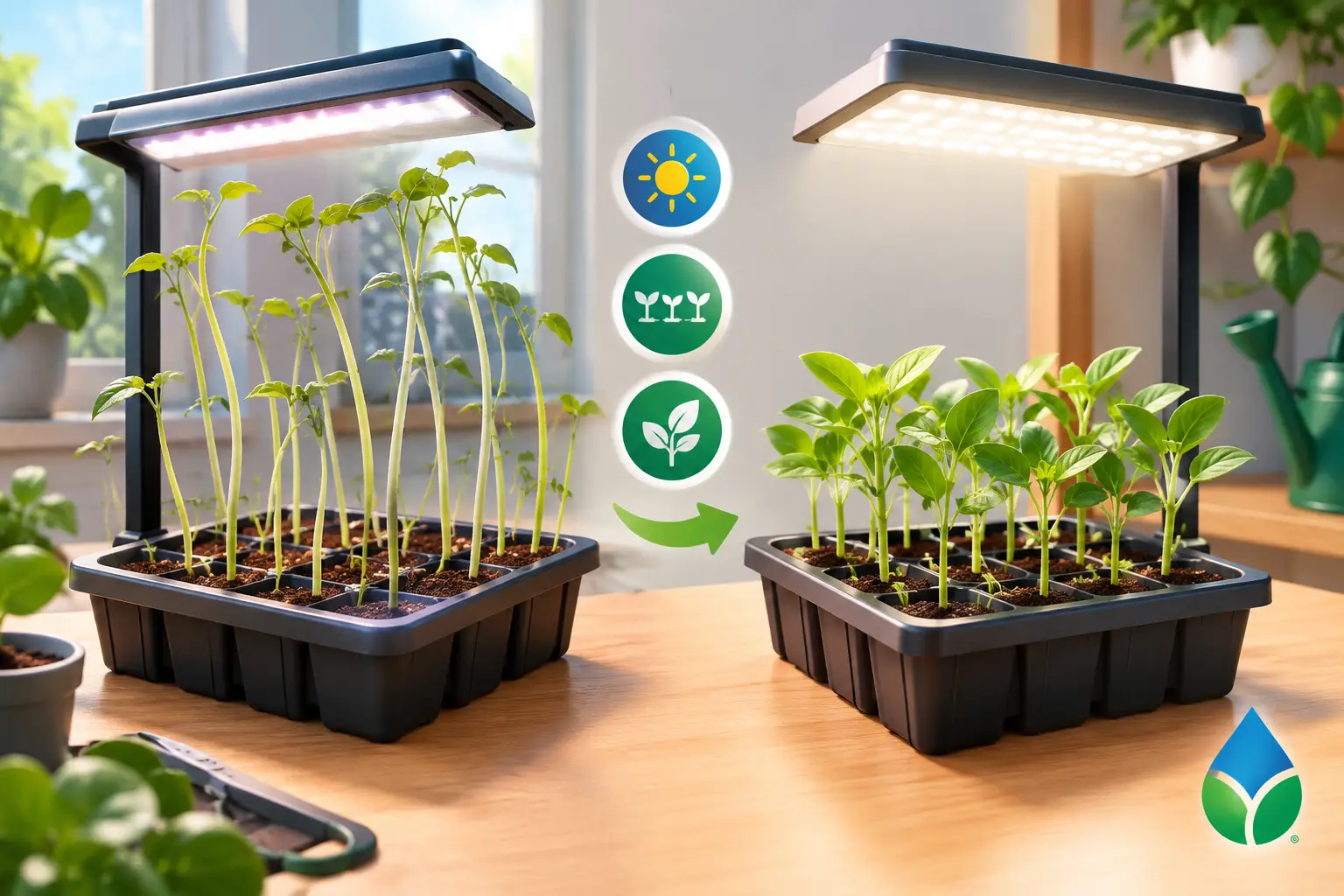
When light intensity is too low, the seedling stretches its internodes – the spaces between leaf sets – in an effort to find more light. This is called etiolation. A plant may remain green and continue making leaves, but the long, pale stem is a warning that its structure is being sacrificed for reach.
A purpose-built LED grow light gives you far more control than a windowsill. Position it at the manufacturer’s recommended height and adjust as the seedlings develop. Too far away produces stretching; too close can bleach foliage, curl leaves or create heat stress. Rather than guessing, watch the plant response over several days: new growth should be compact, evenly coloured and upright.
Photoperiod matters as well. Most seedlings benefit from a consistent daily light period, commonly around 14 to 18 hours depending on the species and your growing plan, followed by a proper dark period. A timer removes the guesswork and prevents the irregular light cycles that come with relying on room lights and windows.
Light comes from the wrong direction
A window supplies light from one side. Seedlings naturally bend towards it, a response known as phototropism. Turning a tray every day can reduce the lean, but it does not improve light intensity. It is a useful short-term measure, not a full solution.
Overhead lighting is the better option for even growth. In a propagation tent or on a dedicated shelf, it encourages seedlings to build a more balanced canopy instead of reaching sideways. If you use a window while waiting for a light setup, place plants as close to the brightest glass as practical without exposing them to cold draughts or scorching afternoon sun.
Excess warmth speeds growth beyond stem strength
Warmth encourages fast growth, especially when paired with low light. That sounds helpful, but it is often the perfect recipe for lanky seedlings. Their cells elongate rapidly while the plant lacks the light energy needed to build strong, dense tissue.
Propagation heat mats are excellent for germination because many seeds emerge more reliably in warm media. Once seedlings have germinated, however, leaving the root zone too warm can encourage unnecessary stretching. Remove the heat mat or use a thermostat to bring temperatures back into a suitable range for the crop.
The ideal temperature depends on what you are growing. As a general rule, seedlings usually prefer moderate daytime conditions and slightly cooler nights than they needed to germinate. Check the needs of your particular plant rather than applying one setting across every tray.
Still air leaves stems soft
Outdoors, seedlings experience a light breeze that gently moves their stems. This movement signals the plant to reinforce itself. Indoors, stagnant air can leave stems thin and tender while also increasing the risk of damp conditions and fungal problems.
Use a small oscillating fan on its lowest setting to keep air moving around, not directly through, young plants. You want a faint flutter in the leaves, not stems pushed over by a constant blast. Good air exchange also helps manage humidity and keeps the propagation area more uniform.
Overcrowding creates a race for light
A tray sown heavily may look productive until seedlings start shading each other. Once leaves overlap, each plant competes for light and reaches upward. Crowding also restricts airflow and makes watering less even.
Thin seedlings early or pot them on when they have developed enough roots to handle the move. Give each plant enough room for its leaves to receive direct overhead light. The right spacing varies with species, but if the canopy is already closing before transplanting, it is time to create more room.
Too much nitrogen can encourage soft growth
Seedlings need nutrition, but more feed does not equal stronger seedlings. Excess nitrogen, particularly in rich potting mixes or overfed hydroponic systems, can create fast, lush and soft growth that is more prone to stretching.
For seedlings in hydro, start with a mild nutrient solution appropriate for propagation and use a calibrated EC meter rather than relying on guesswork. In coco or other inert media, seedlings need a gentle, balanced feed from early on, but the EC should remain conservative until the root system develops. Check pH too, because a nutrient mix can be present in the reservoir yet unavailable to the plant if the pH is outside the suitable range.
In soil-based mixes, avoid adding extra fertiliser simply because growth seems slow. First check light level, temperature and watering. Those are more often responsible for leggy growth than a lack of nutrients.
How to stop leggy seedlings before they start
The most effective approach is to build a stable propagation environment from day one. Start with a light that matches the size of your tray or shelf, set on a timer, and keep it close enough to provide useful intensity without stressing tender foliage. A dim light left on longer cannot fully replace sufficient intensity.
Keep temperatures appropriate for the crop after emergence. If you are using a humidity dome, remove or vent it once seedlings are up and growing, unless the species specifically needs high humidity. Constantly high humidity can slow stem strengthening and increase the chance of damping-off.
Water with care. Media that stay soaked reduce oxygen around the roots, making seedlings less resilient. Allow an appropriate level of dry-back for your substrate, while avoiding the repeated wilt-and-flood cycle that checks growth. In hydroponic systems, maintain clean water, steady pH and a sensible EC for the seedling stage.
A simple daily check catches problems while they are easy to fix. Look for these signs:
- Stems becoming longer and thinner between each new leaf set
- Seedlings leaning hard towards a window or the edge of the light
- Pale new leaves combined with rapid upward growth
- Plants falling over despite moist media and no obvious pest damage
If you see these signs, improve light first, then review temperature, spacing and airflow. Changing five variables at once makes it hard to learn what solved the issue.
Can you save leggy seedlings?
Often, yes. How much you can recover depends on the plant type and how severely it has stretched. Many seedlings can be transplanted deeper, covering part of the stem to provide extra support. Tomatoes are a familiar example because they can form additional roots along a buried stem. Other plants are less forgiving, so do not assume every species can be planted deeply without risk of rot.
For seedlings that cannot be buried deeper, use a small support temporarily and correct the environment immediately. Move them under adequate overhead light, introduce gentle airflow and avoid heavy feeding. New growth will not shorten the existing stem, but it can grow denser and stronger.
If a seedling is extremely stretched, pale and collapsing, starting again can be the better use of time and space. That is not a failure. A fresh batch raised under corrected conditions will usually overtake a stressed plant within a few weeks.
Set your propagation area up for stronger plants
The goal is not to force rapid growth. It is to produce a seedling with a thick stem, short internodes, healthy roots and leaves that are ready to handle transplanting. That foundation pays off later through better canopy control, more efficient photosynthesis and plants that respond more predictably through each growth stage.
For growers building or refining an indoor setup, Hunter Hydro can help match propagation lighting, timers, fans, meters and nutrient options to your plant type and available space. The best equipment is the equipment sized correctly for your grow, not simply the biggest option on the shelf.
A compact seedling is built in small daily decisions: enough overhead light, sensible temperatures, clean root-zone management and just enough airflow to encourage strength. Get those conditions right now, and your young plants will have every chance to grow into productive, resilient plants later.