How to Prevent Fungus Gnats in Your Grow Room
A few tiny flies lifting off the surface of a pot may seem harmless, but they are often a warning that your root zone is staying too wet. Learning how to prevent fungus gnats early protects young roots, reduces plant stress and saves you from chasing a much bigger pest issue later. For indoor gardens, propagation areas and hydroponic setups, the answer is rarely one product. It is a cleaner, drier and better-managed growing environment.
Adult fungus gnats are more annoying than destructive. Their larvae are the real problem. They live in moist media and feed on fungi, algae, decaying organic matter and, when numbers build, tender root hairs. Seedlings, cuttings and recently transplanted plants are most vulnerable because they have limited root mass to begin with. A small infestation can quickly slow growth, create uneven watering behaviour and leave plants struggling to take up nutrients.
How to prevent fungus gnats before they establish
Fungus gnats need moisture and organic material to complete their life cycle. Break either part of that equation and the population drops. In a warm grow room, adults can reproduce quickly, so prevention starts with treating every damp surface around your plants as a potential breeding site.
The biggest mistake is keeping media constantly wet. Soil, coco and peat-based mixes should not stay saturated from top to bottom between irrigations. Allow the upper layer to dry appropriately for the plant and medium before watering again. This does not mean starving plants of water. It means matching irrigation frequency and volume to pot size, root development, temperature, airflow and plant demand.
A rooted plant in a well-filled pot can generally handle more frequent watering than a fresh cutting in a large container. Overpotting is a common cause of fungus gnat pressure because the unused media stays wet long after the small root system has taken what it needs. Start young plants in suitably sized containers, then transplant as the roots develop.
Get the wet-dry balance right
For soil-grown houseplants and indoor crops, check moisture below the surface rather than judging the pot by its top layer alone. Lift smaller pots to learn their watered and near-dry weight. For larger containers, a moisture probe can help, but your own observation matters just as much.
Coco is often irrigated more frequently than soil, particularly in high-performance cultivation. Even so, the surface should not become a permanent damp habitat. Avoid runoff sitting in saucers or trays, and ensure pots are draining freely. If you are hand watering, use measured volumes rather than adding a little water every day out of habit.
In hydroponic systems, fungus gnats are less likely to breed in a properly managed reservoir than in wet propagation media, exposed rockwool, coco-filled net pots or algae-covered drain areas. Keep light out of nutrient solution, clean spills promptly and make sure drain-to-waste runoff does not pool beneath plants. Good sanitation also limits algae, which can make the area more attractive to gnats.
Start with clean media, pots and propagation gear
Fungus gnats often arrive with new plants, bagged growing media or dirty reused pots. You cannot control every source, but you can avoid giving pests an easy entry point.
Use clean, quality media and store unopened or partly used bags off the floor in a dry place. Once a bag is open, reseal it well. Do not leave old potting mix, leaf litter or discarded root balls beside the grow area. That damp organic material is an ideal nursery for larvae.
Before reusing pots, trays, domes or propagation inserts, remove old media and wash away visible residue. Disinfect equipment between crop cycles, especially after a pest outbreak. Pay attention to the small places growers often miss: under trays, around drainage holes, beneath benches and inside saucers.
New plants deserve a quick inspection before they join the main garden. Look for adults hovering near the media and check for unusually wet pots. A short quarantine period is worthwhile if you have valuable mother plants, seedlings or a tightly packed indoor space. It is far easier to manage one suspect plant than a whole tent full of them.
Manage the top layer of the growing medium
Because adult females lay eggs near the media surface, changing that surface can make a meaningful difference. A light top dressing of coarse perlite, horticultural grit or another clean, fast-drying material can reduce the damp organic zone where eggs are laid. The best choice depends on your setup and irrigation method.
Top dressings are not magic. A thick layer can make it harder to assess moisture, interfere with gentle hand watering or alter how water enters the pot. In coco systems using frequent drip irrigation, correcting irrigation timing and runoff management is usually more useful than relying on a surface barrier alone.
Avoid decorative moss on top of indoor pots if fungus gnats are already a recurring issue. It holds moisture at the exact place gnats prefer. Likewise, remove dead leaves from the medium instead of allowing them to break down around the stem.
Improve airflow and eliminate damp corners
Air movement is not just about strengthening stems and helping plants transpire. It helps the media surface dry more evenly and prevents humid, stagnant pockets around trays and pots. Position circulation fans so they move air through the room rather than blasting one plant continuously.
Check airflow at bench level and under dense foliage, not only at canopy height. A grow room can have plenty of extraction while still holding damp, still air around propagation trays. If humidity remains high after lights-off, review extraction, dehumidification and watering timing. Watering early in the light cycle gives plants and the room more time to process moisture before temperatures fall.
Clean standing water from saucers, floors and catch trays. Leaking irrigation fittings, overflowing reservoirs and blocked drains can all create hidden breeding zones. In a greenhouse, look under benches and around stored pots after watering. Those places are often where a minor problem keeps restarting.
Monitor adults before larvae cause damage
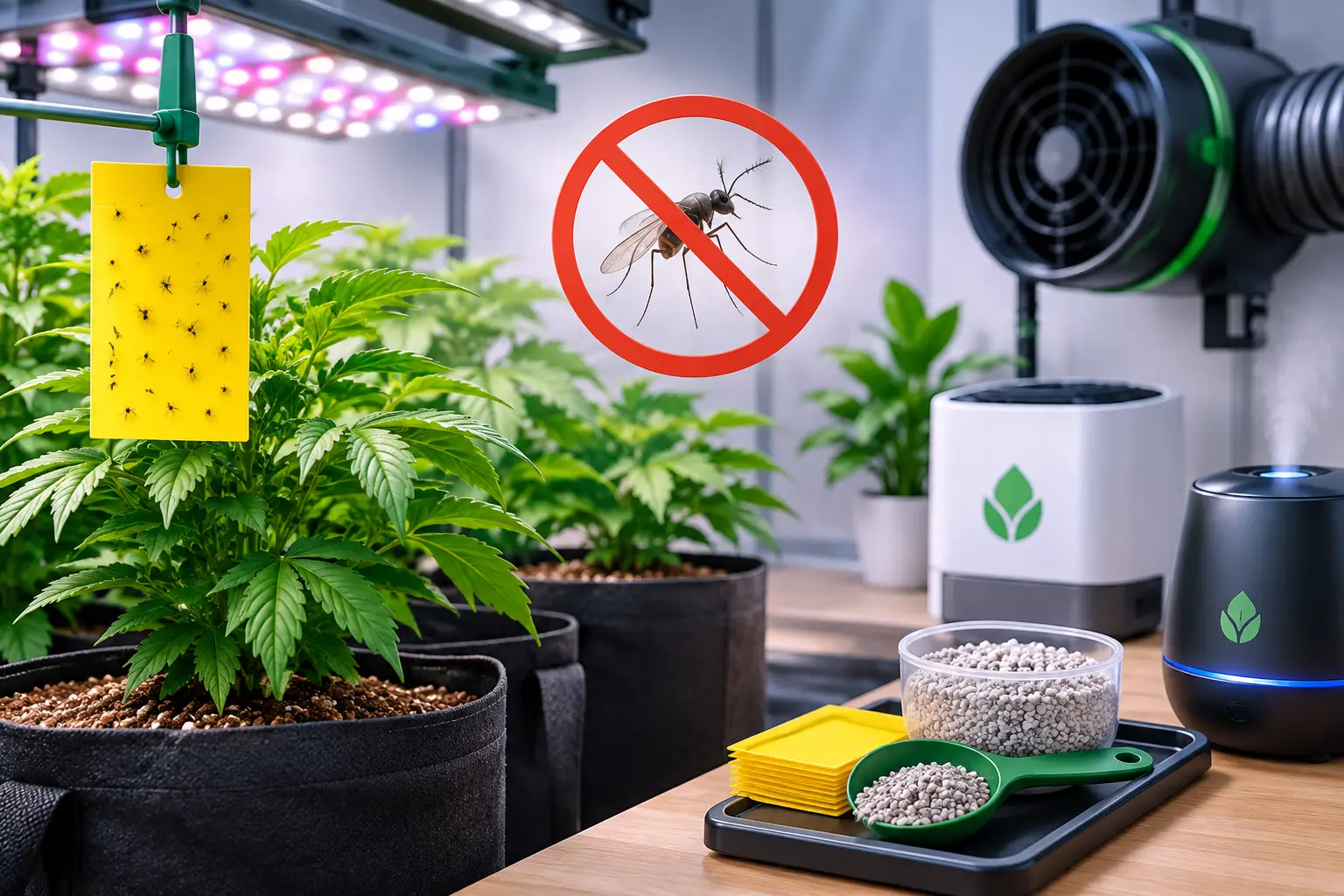
Yellow sticky traps are a simple monitoring tool, not a complete cure. Place them close to the media surface, where adult fungus gnats fly, rather than only hanging them high above the canopy. They help you confirm whether gnats are present and show whether your control measures are working over the next couple of weeks.
Replace traps when they become dusty or crowded. Do not judge an infestation from one trap alone. Put a few around the area, especially near propagation zones, damp plants and entrances where new stock comes in.
If you see only an occasional adult, improve watering and hygiene straight away. If traps are catching increasing numbers, assume larvae are already in the medium and act at the root zone. Waiting until adults are everywhere means several life cycles may already be underway.
Treat the larval stage when prevention is not enough
For an established infestation, target larvae as well as adults. Biological controls containing beneficial bacteria, such as Bacillus thuringiensis israelensis, can be used as a drench where suitable for the crop and product directions. Beneficial nematodes are another option for moist media, particularly when you need a biological approach and conditions allow them to remain active.
These treatments work best when paired with environmental correction. Applying a larval control while continuing to overwater is like emptying a tray while the tap is still running. Follow label directions closely, consider crop stage and avoid mixing products without checking compatibility.
For valuable crops or recurring infestations, it is worth reviewing your entire root-zone routine: pot size, media structure, watering schedule, drainage, humidity and cleanliness. Measuring pH and EC also helps in hydroponic and coco gardens. Plants stressed by an unsuitable root-zone environment are slower to recover from pest feeding, even after the gnats are gone.
A practical weekly routine for gnat-free plants
A short weekly check is usually enough to prevent a repeat problem. Inspect sticky traps, lift a few pots to assess moisture, remove dead plant material and check that trays and drains are dry and clean. Look closely at seedlings, cuttings and newly purchased plants, as these are common starting points.
If your garden has had fungus gnats before, make these checks part of each watering day rather than a reaction once flies appear. Consistency delivers better results than heavy treatment after the fact.
Healthy roots are the foundation of faster growth, stronger nutrient uptake and better yields. Keep the root zone clean, irrigate with purpose and act on the first signs of excess moisture. If you are unsure whether your media, irrigation setup or environmental control is contributing to the problem, the Hunter Hydro team can help match a practical solution to your plants and growing style.