What EC for Hydroponic Lettuce Works Best?
A lettuce crop can look perfectly healthy one week, then develop burnt leaf edges, slow growth or a bitter flavour seemingly overnight. Often, the issue is not the light or the variety – it is nutrient strength. If you are asking what EC for hydroponic lettuce to use, start with a moderate solution: lettuce generally performs best at 0.8 to 1.4 mS/cm.
That range is a useful starting point, not a fixed rule. Seedlings need less, mature plants can use a little more, and your source water, system type and growing conditions all affect the final number. The goal is to provide enough nutrition for fast, crisp growth without creating unnecessary stress in a crop that is naturally light-feeding.
What EC for hydroponic lettuce is ideal?
For most home hydroponic lettuce crops, aim for these EC ranges:
- Seedlings and newly transplanted plants: 0.4 to 0.8 mS/cm
- Young vegetative lettuce: 0.8 to 1.0 mS/cm
- Established, actively growing lettuce: 1.0 to 1.4 mS/cm
- Large, fast-growing plants in stable conditions: up to 1.6 mS/cm, used carefully
A target of around 1.0 to 1.2 mS/cm is a reliable sweet spot for many butterhead, cos, loose-leaf and oakleaf varieties. It supplies the nitrogen, calcium, potassium and trace elements lettuce needs while leaving a sensible margin for warmer weather or minor changes in reservoir concentration.
Lettuce does not usually reward the grower who pushes EC high. Unlike heavy-feeding fruiting crops, it has a short growing cycle and a leafy growth habit. A stronger mix can make the root zone harder for plants to draw water from, especially when temperatures rise. The result may be darker leaves but slower growth, tip burn, curled margins or a harsher taste.
What EC actually tells you
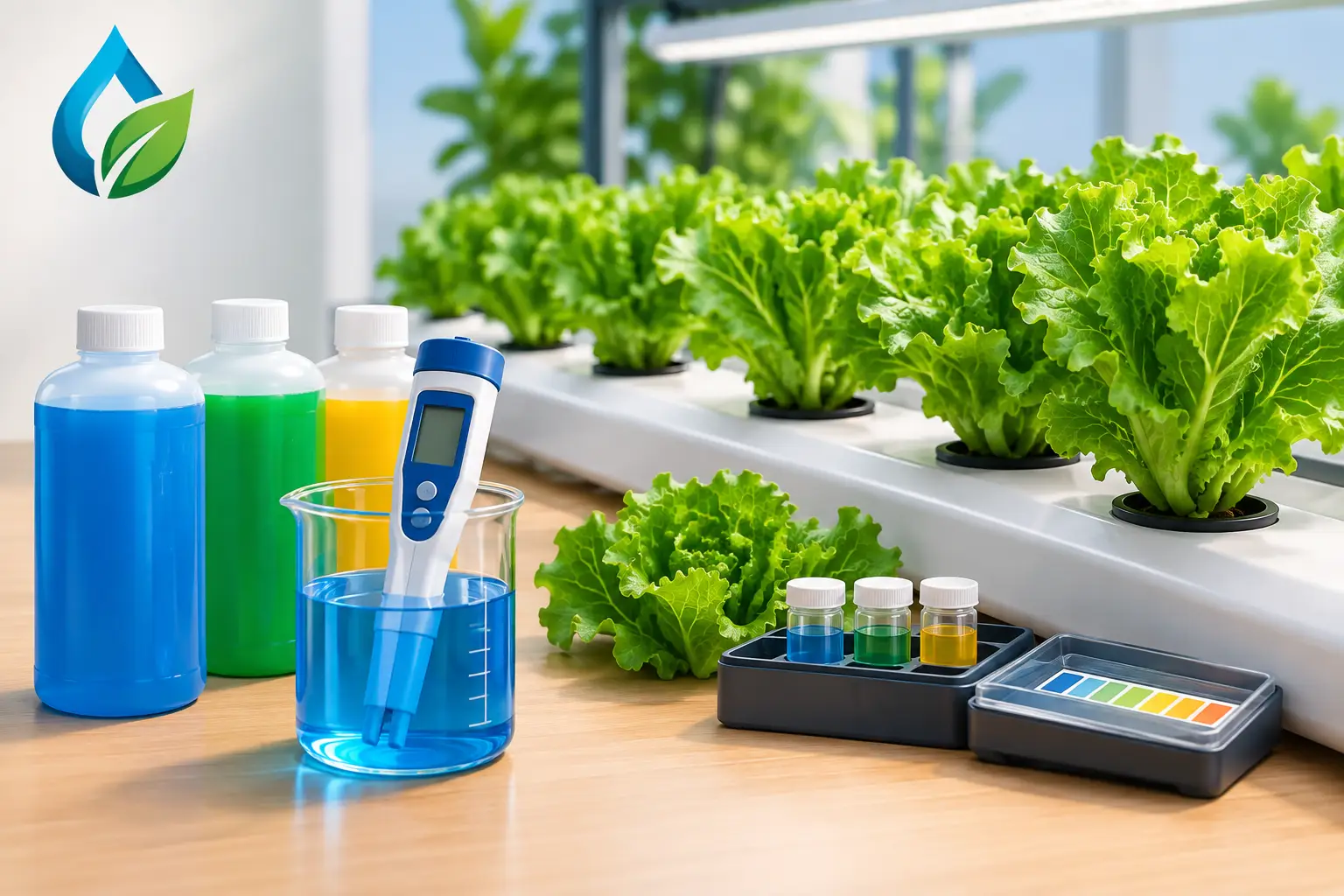
EC stands for electrical conductivity. An EC meter measures how well your nutrient solution carries an electrical current, which gives an indication of the total concentration of dissolved mineral salts.
It is a very useful management tool, but it does not tell you whether the nutrients are correctly balanced. Two reservoirs can show the same EC while having very different nutrient profiles. That is why using a complete hydroponic nutrient formulated for leafy greens, or a balanced grow nutrient suited to your system, matters as much as hitting the number on the meter.
Measure EC after adding nutrients and thoroughly mixing the reservoir. Do not measure concentrated nutrient bottles, and do not add separate additives just to chase a higher reading. A complete, well-mixed solution at 1.1 EC is more useful than an unbalanced brew pushed to 1.5 EC.
Start with your water, not the nutrient chart
Your water supply already has an EC before nutrients go in. Rainwater and reverse-osmosis water may begin close to 0.0 EC, while some Australian tap water can start at 0.3 EC or more. That baseline matters.
For example, if your tap water reads 0.3 EC and your chosen target is 1.1 EC, add nutrients until the final reservoir reading reaches 1.1 EC. Do not add enough nutrient to raise the water by a further 1.1 EC unless the nutrient manufacturer specifically instructs you to calculate that way.
Hard water can also contain significant calcium, magnesium, sodium or bicarbonates. Calcium and magnesium may be useful in moderation, but high sodium is not. If your starting water EC is consistently high, particularly above about 0.5 EC, a lower-mineral source or filtered water may give you more control over your nutrient recipe.
Match EC to lettuce growth stage
Small seedlings have limited roots and low nutrient demand. Starting them at a high EC can slow root development and make early growth uneven. Once roots are established and plants have several true leaves, lift EC gradually into the main growing range.
A change of around 0.1 to 0.2 EC at a time is usually plenty. There is no need for daily adjustments unless your reservoir is very small or environmental conditions are changing rapidly. Lettuce prefers consistency.
As heads begin filling out, growers are sometimes tempted to increase EC for a final growth push. This can work in cool, well-managed conditions, but it is not automatically the best move. In a warm grow tent, greenhouse or NFT channel exposed to hot afternoons, maintaining EC near 1.0 to 1.2 can be safer than increasing it. Mild nutrient strength supports steady water uptake, which is critical for tender leaves.
EC, pH and temperature work together
EC is only one part of reservoir management. For hydroponic lettuce, keep pH generally between 5.5 and 6.2, with about 5.8 to 6.0 being a practical target. Within this range, key elements such as calcium, magnesium, iron and phosphorus remain readily available to the plant.
If pH drifts too high, lettuce can show deficiency symptoms even when EC is on target. If it drops too low, nutrient uptake may also become uneven. Check pH after mixing nutrients, then monitor it routinely rather than adjusting it obsessively every few hours.
Water temperature deserves the same attention. Lettuce roots favour cool, oxygen-rich water. Once nutrient solution gets too warm, dissolved oxygen falls and the chance of root stress increases. Warm water also makes high EC less forgiving because plants can struggle to take up moisture at the pace their leaves lose it.
For deep water culture and reservoir systems, aim to keep solution temperatures roughly in the high teens to low twenties Celsius where possible. Insulating reservoirs, keeping them out of direct sun and maintaining good aeration can make a noticeable difference during an Australian summer.
Reading your plants and reservoir
The EC number tells part of the story; the plants and the reservoir trend tell the rest. Check EC at roughly the same time each day or every second day, particularly in smaller systems.
When water level falls and EC rises, plants are using more water than nutrients. Top up with plain water, then reassess. When water level falls and EC drops, plants are taking nutrients up strongly. If the crop is healthy, this may simply mean the reservoir needs a fresh, correctly mixed top-up sooner.
If both water level and EC remain fairly stable, your nutrient strength is likely close to the plant’s needs. This is where a reliable EC meter earns its place – not as a number to chase, but as a way to see what your crop is doing.
Watch for signs that may call for a change. Pale new growth and generally slow development can point to EC that is too low, though poor light, cold roots and incorrect pH can cause similar symptoms. Dark, leathery leaves, browned edges, wilting in warm periods or reduced growth can indicate EC is too high.
Tip burn deserves special care. The crisp brown edges seen on inner leaves are often blamed on a lack of calcium, but the nutrient may already be present in the solution. Rapid growth, warm conditions, poor airflow and irregular water movement can prevent calcium reaching developing leaf tissue. Before adding more calcium or lifting EC, check temperature, airflow, root health and reservoir circulation.
System type changes how closely you monitor
NFT, DWC, kratky jars and recirculating systems can all grow excellent lettuce, but they behave differently. In a small kratky container, water level and EC can change quickly as the plant grows, so check it more often. In DWC, good aeration and water temperature control are central to healthy roots. In NFT, ensure a steady flow and avoid allowing channels or nutrient tanks to overheat.
A larger reservoir gives you more buffering and makes daily swings less dramatic. Small reservoirs are perfectly workable, but they demand a little more attention. For either setup, replace the nutrient solution regularly rather than endlessly topping it up. This helps prevent nutrient ratios drifting out of balance over the crop cycle.
A practical mixing routine
Use clean water in a clean reservoir, add your base nutrient according to its directions, mix thoroughly, then test EC. Adjust nutrient strength slowly until you reach your target range. Check pH last, because nutrients can alter it. Record the starting EC, pH and date on a simple note near the reservoir.
Calibrate your EC meter with the appropriate calibration solution and rinse the probe with clean water after use. A quality meter is only useful when it is clean and reading accurately. Also avoid comparing EC directly with a TDS or ppm chart unless you know the conversion factor used by that meter – EC is the more consistent measurement.
For dependable lettuce, begin around 1.0 to 1.2 EC, keep the root zone cool and well oxygenated, and make changes in small steps. Your plants will soon show you whether that setting suits your particular water, variety and growing space. If the readings or symptoms do not add up, practical advice from an experienced hydroponics team can save a crop and make the next one even better.