
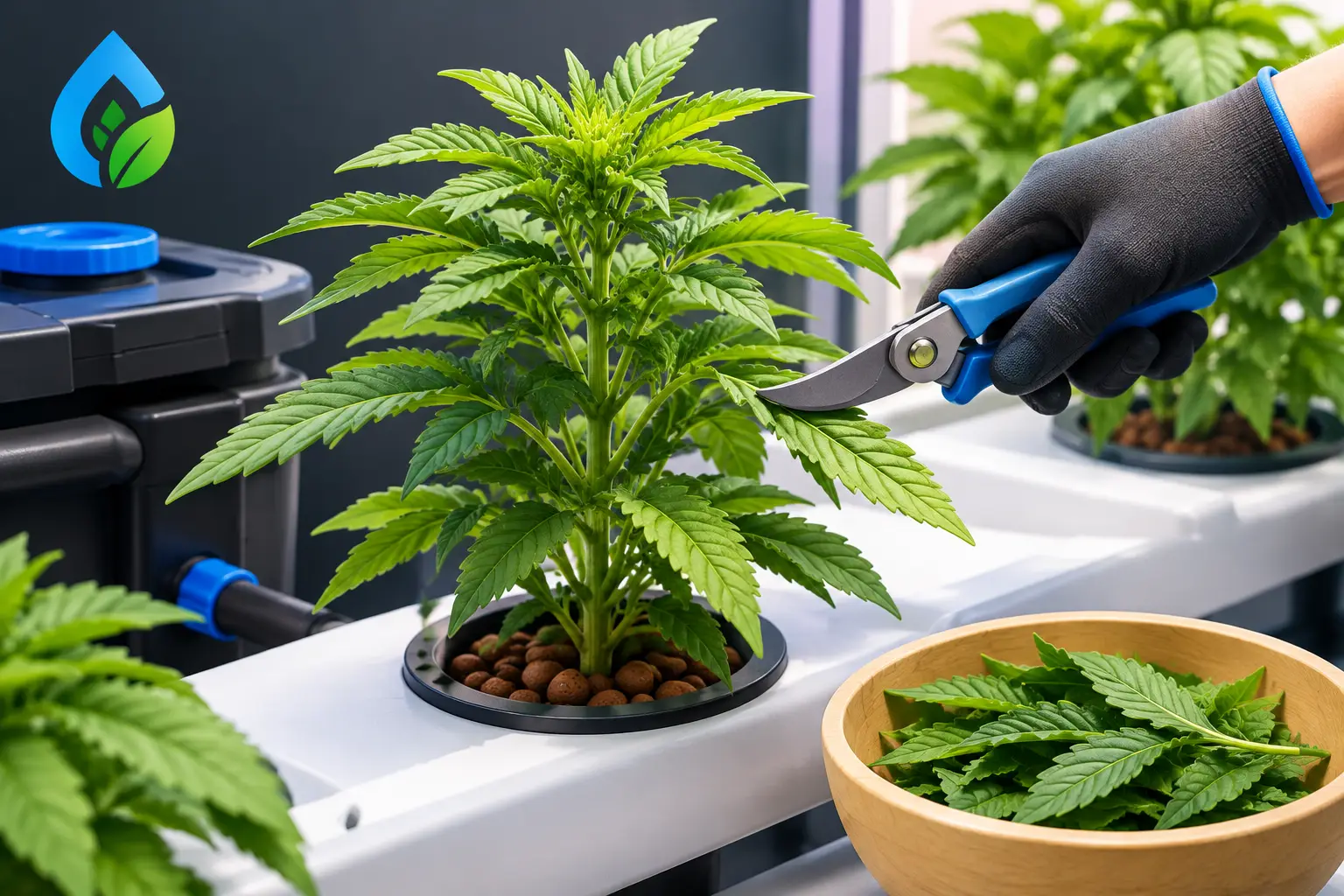
A dense indoor canopy can look impressively green while quietly creating problems underneath. Lower leaves may receive little useful light, humidity can linger between crowded branches, and airflow may not reach the places where fungal issues begin. Plant defoliation is the deliberate removal of selected leaves to improve the growing environment – not a race to leave every stem bare.
Done at the right time, it can help direct light and airflow towards productive growth. Done too hard or too often, it reduces the plant’s ability to photosynthesise, slows recovery and can create more stress than benefit. The best approach is selective, measured and based on what your particular plant is telling you.
What plant defoliation actually does
Leaves are solar panels. They capture light, support photosynthesis and help power root development, flowering and fruit production. That is why healthy leaves should never be removed simply because they are there.
The value of defoliation comes from removing leaves that are no longer doing a useful job, or that are actively limiting the performance of the rest of the plant. A yellowing leaf, a damaged leaf, one resting on wet media, or a large fan leaf completely shading several healthy growth sites may be worth removing. Clearing these leaves can improve air movement, reduce stagnant humid pockets and give interior growth better access to light.
In a tent, greenhouse or closely planted garden bed, the benefit is often environmental control rather than a dramatic change in plant size. Better air exchange around the canopy supports more even transpiration. This helps plants move water and nutrients from the root zone to the leaves, especially when temperature, humidity, irrigation and airflow are all working together.
Defoliation does not replace good spacing, suitable extraction, oscillating fans or correct watering. If a canopy is repeatedly becoming overcrowded, the better solution may be to train, space or prune the plant earlier next cycle.
When should you remove leaves?
Start with plant health. A well-rooted, actively growing plant with stable light, nutrition and irrigation is far more capable of handling minor pruning than a plant already struggling with heat, pests, nutrient imbalance or root-zone issues.
The vegetative stage is usually the safest time for light shaping. Removing a few large, blocking leaves can expose developing shoots and make it easier to establish an even canopy. Avoid taking too much at once. Give the plant time to respond, then reassess after several days of healthy growth.
During the transition into flowering or fruiting, modest clean-up can improve airflow and remove weak, heavily shaded lower growth that is unlikely to become productive. This is particularly useful for fruiting plants grown under lights, where an even canopy lets you make the most of your available light footprint.
Once flowers or fruit are well established, be more conservative. Removing dead, diseased or badly shaded leaves still makes sense, but heavy defoliation at this stage can interrupt the plant when it needs energy most. The timing depends on the species, cultivar, plant vigour and environment. Tomatoes, chillies and leafy ornamentals all respond differently, so there is no single leaf-removal schedule that suits every crop.
Signs a plant may benefit from defoliation
Look through the canopy rather than judging it from above. If lower leaves are permanently shaded, branches are packed tightly together, or moisture remains trapped after lights-off or watering, selective leaf removal may help.
A few signs are worth acting on promptly: yellow or dying leaves, leaves with pest damage, foliage touching the growing media, and dense leaf clusters blocking airflow through the middle of the plant. Remove diseased material carefully and keep it away from healthy plants. Do not compost clearly infected leaves unless you are confident your composting system reaches suitable temperatures.
Healthy, well-positioned leaves are different. If a leaf is green, receiving light and supporting an active branch, it is usually contributing more than it is costing. Tucking a leaf out of the way can sometimes achieve the same result without removing it.
How to defoliate without setting plants back
Use clean, sharp snips or scissors for thicker leaf stems. For small leaves that detach easily, clean hands can work, but avoid tearing tissue or pulling on branches. Wipe tools between plants, and disinfect them when moving from any plant with suspected pests or disease.
Work in small passes. First remove fully yellow, damaged or unhealthy leaves. Next, deal with leaves touching the medium or blocking ventilation. Only then consider removing healthy leaves that heavily shade multiple sites. This order keeps the process focused on practical gains instead of appearance.
For most home growers, taking a small number of leaves in one session is safer than stripping a whole section of canopy. Watch for recovery over the next few days. Strong plants should maintain leaf posture, continue new growth and drink normally. If growth stalls or leaves droop unexpectedly, check the broader conditions before taking more foliage.
Keep the rest of the grow dialled in after pruning. A plant needs adequate light, a stable temperature, good airflow and correctly managed water and nutrients to recover well. In hydroponic systems, confirm that pH and EC are appropriate for the crop and growth stage. Defoliation will not solve deficiencies caused by an unbalanced reservoir, nor will it compensate for poor root oxygenation.
Light penetration is useful, but not the whole story
Growers often defoliate to get more light deeper into the canopy. That can be useful, but it has limits. Light intensity drops quickly below a dense top layer, and removing a handful of leaves cannot turn weak lower growth into top-canopy growth.
Instead, combine selective defoliation with sensible plant training and lighting. An even canopy places more active growth at a consistent distance from the grow light. Branches receive more balanced coverage, and you are less likely to have a few tops receiving excessive intensity while lower sites remain shaded.
Check light distance and plant response before removing lots of foliage. Bleached upper leaves, curling edges and upward leaf cupping may point to excess light or heat, not a need for more defoliation. Conversely, stretched internodes and thin lower growth may indicate insufficient light intensity or poor canopy management.
Common plant defoliation mistakes
The most common mistake is removing too many healthy leaves at once. A dramatic before-and-after photo may look tidy, but plants do not benefit from being left with too little photosynthetic surface. Large-scale leaf removal can be especially hard on young plants, recently transplanted plants and anything recovering from pest pressure or environmental stress.
Another mistake is treating every shaded leaf as useless. Some shaded leaves still contribute energy, while others can be repositioned with gentle training. It also pays to avoid defoliating immediately before a heatwave, after a reservoir change, or when the plant is thirsty. Stack enough stressors together and even a vigorous plant can lose momentum.
Finally, do not mistake cleanliness for health. A neat canopy is helpful only when it improves light distribution, airflow or disease prevention. Your aim is a productive plant with enough leaf area to keep growing strongly, not a perfectly bare framework.
A practical rule for better results
Before removing any leaf, ask three questions: is it unhealthy, is it restricting airflow, or is it substantially blocking more productive growth? If the answer is no, leave it for now. That simple check prevents most over-pruning.
Every grow space has its own balance of plant type, available light, humidity, ventilation and grower goals. If you are unsure how far to go, start conservatively and observe the response. At Hunter Hydro, we find the most reliable results come from matching canopy work with the right lighting, airflow and nutrient management – because bigger yields are made simple when every part of the environment supports the plant.